This month we spoke with two recruiters about what trends they're observing with hiring managers lately, and what guidance they would provide to optimize their processes, and give themselves the best odds of finding the right person for the job, and for the company.
--
Meet this month's Recruiter Roundtable:

Neha Khurram is a Career Transition & Startup Coach with over 12 years of experience helping ambitious professionals navigate the tech ecosystem across North America. Drawing from her experience hiring 1000+ tech candidates and leading the venture community at MaRS, her advisory spans job search strategy, personal branding, leadership development, and entrepreneurship in the age of AI.

Adam Gellert, Founder and CEO of Linkus Group, has spent more than two decades helping technology companies build high-performing teams. Through his work with founders and executives, he has a front-row view of how AI is reshaping hiring, talent strategy, and the way companies think about building teams.
--
Adam Gellert: The purpose of interviews isn't to eliminate people. It's to discover them.
Most hiring managers approach interviews like an audit. Find the gap. Find the inconsistency. Find the reason to say no. It feels rigorous.
It's actually just fear dressed up as diligence.
Neha Khurram: When candidates don't go deep enough there is an opportunity for the interviewers to ask more follow up questions.
My advice is to proactively restate the question and ensure you’re extracting the right information from the candidate rather then expecting them to read your mind.
Hiring mistakes often happen when we overindex on presentation, polish, and instant chemistry compared to evidence of past performance and testing relevant skills. Ask for specific examples and probe for results and impact.

Neha Khurram: Employers need to know what their dealbreakers are and what can reasonably be worked on.
Past performance is the best indicator of potential and transferable skills are particularly relevant when the candidate is aware of how their skills apply to a new setting. Translate your work environment into layman's terms.
Oftentimes, candidates will offer relevant examples that might otherwise be missed if company jargon obscures the problems to be solved.
Be sure to probe into tangible results, ask them about their near term and long term goals, and use motivational mapping to uncover their interests and priorities. This allows you to assess skills, fit, and potential rather than focusing on what can reasonably be learned.
Adam Gellert: The better question isn't "what's wrong with this person." It's "what's this person capable of that isn't on the resume yet." Potential doesn't show up in a bullet point. It shows up in how someone thinks through a problem live, in the room, under a little pressure.
Candidates make the same mistake in reverse. They walk in trying to deliver the "correct" answer instead of showing how they actually think. Hiring managers don't remember perfect answers. They remember the moment someone worked through something hard, out loud, in real time. That's the moment that gets you hired.
Stop checking boxes. Start solving the actual problem.
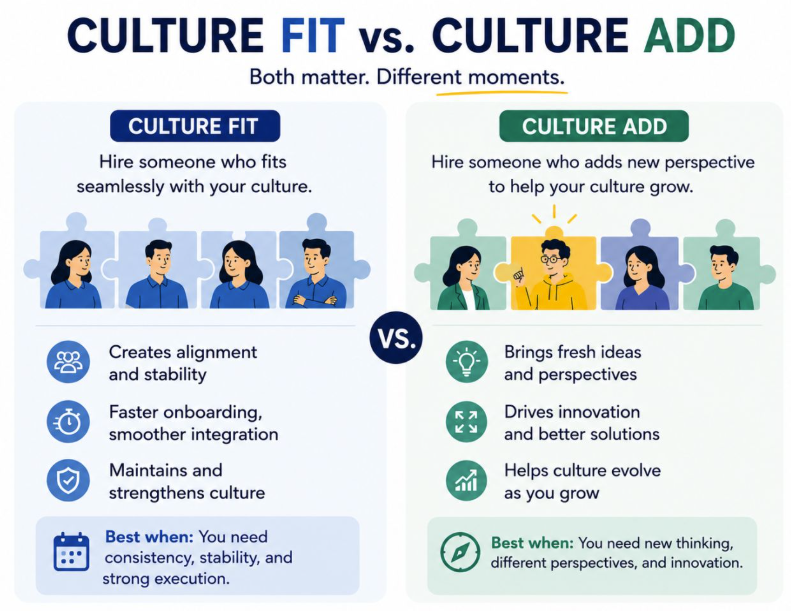
Adam Gellert: "Culture fit" is the most misused phrase in hiring.
Most companies use "culture fit" as a proxy for "reminds me of me." That's not culture fit. That's a bias with better branding, and it's how you end up with a team of people who all think the same way and none of you catch the same blind spot.
Real culture fit is alignment on values, on expectations, and on how people work together to get results. It has nothing to do with personality overlap.
Some of the best hires I've placed were nothing like the team they joined, and that's exactly why they made the team better.
Neha Khurram: There are several.
Not setting clear timelines and following up inconsistently; lacking enthusiasm about their background; not asking about other interview processes and what their priorities are.
Top talent needs to be sold on you as much as you need to be sold on them. Top candidates have leverage and can easily decline an interview. To stand out as an employer of choice, understand the candidate's unique priorities, build trust early, and pay closer attention to the candidate experience.
Adam Gellert: Here's the part most hiring managers skip: they expect candidates to show up fully prepared, but they don't prepare the candidate experience at all. No context on the team. No real conversation about what the role actually needs. No effort to make the person comfortable enough to be honest.
The best interviews are a two-way conversation, not a one-way audit. Great candidates are evaluating you exactly as hard as you're evaluating them. If you're only asking questions and never selling the opportunity, you're not interviewing. You're gatekeeping. And your best candidates, the ones with options, will simply go somewhere that treated the process like a relationship instead of a test.
I've watched companies lose exceptional people to a competitor with a weaker offer, purely because the other company moved faster and made the candidate feel wanted. Speed isn't just operational efficiency. It's a signal. Long or inconsistent processes tell candidates exactly how decisions get made inside your company, and most of the time, that's not the message you meant to send.
Neha Khurram: Companies that can function without a hire for months should consider whether that seat needs to be filled in the first place.
If there are no operational gaps but the budget has been approved, it may make more sense to assign bonuses or career growth opportunities to the teammates filling in to manage the gap provided they are not over capacity.
However, in many cases, the costs of waiting to hire are immense. The company may miss targets, colleagues may feel the company is chaotic, and an impression of disengagement may push top employees out.
There is a domino effect when waiting too long. That being said, 'hire slow, fire fast' has its merits. Setting a defined timeline for a decision and calculating the costs particularly if it is a revenue generating role helps mitigate impact with interim solutions such as a potential secondment for an interested and available employee.
Adam Gellert: Hiring is a revenue function, not an HR function.
Every day a critical role sits open, you're paying for it. Lost deals. Burned-out teams covering the gap. Momentum you don't get back. Treat an open seat like an open invoice. Somebody's paying it whether you track it or not.
That's the lens the best hiring managers I've worked with actually operate from. They don't think of hiring as a task to delegate and forget. They think of it as a pipeline, the same way they think about revenue.
Urgency. Follow-through. Ownership of the outcome, not just the process.
Mentorship program and in-person event experiences are at an extra cost.
Join for free!Join the TPMA Slack Community with 1000+ members
Free Virtual TPMA events for the entire TPMA Season
Become the first to know about in-person events and networking opportunities
This month we spoke with two recruiters about what trends they're observing with hiring managers lately, and what guidance they would provide to optimize their processes, and give themselves the best odds of finding the right person for the job, and for the company.
--
Meet this month's Recruiter Roundtable:
Neha Khurram is a Career Transition & Startup Coach with over 12 years of experience helping ambitious professionals navigate the tech ecosystem across North America. Drawing from her experience hiring 1000+ tech candidates and leading the venture community at MaRS, her advisory spans job search strategy, personal branding, leadership development, and entrepreneurship in the age of AI.
Adam Gellert, Founder and CEO of Linkus Group, has spent more than two decades helping technology companies build high-performing teams. Through his work with founders and executives, he has a front-row view of how AI is reshaping hiring, talent strategy, and the way companies think about building teams.
--
Adam Gellert: The purpose of interviews isn't to eliminate people. It's to discover them.
Most hiring managers approach interviews like an audit. Find the gap. Find the inconsistency. Find the reason to say no. It feels rigorous.
It's actually just fear dressed up as diligence.
Neha Khurram: When candidates don't go deep enough there is an opportunity for the interviewers to ask more follow up questions.
My advice is to proactively restate the question and ensure you’re extracting the right information from the candidate rather then expecting them to read your mind.
Hiring mistakes often happen when we overindex on presentation, polish, and instant chemistry compared to evidence of past performance and testing relevant skills. Ask for specific examples and probe for results and impact.
Neha Khurram: Employers need to know what their dealbreakers are and what can reasonably be worked on.
Past performance is the best indicator of potential and transferable skills are particularly relevant when the candidate is aware of how their skills apply to a new setting. Translate your work environment into layman's terms.
Oftentimes, candidates will offer relevant examples that might otherwise be missed if company jargon obscures the problems to be solved.
Be sure to probe into tangible results, ask them about their near term and long term goals, and use motivational mapping to uncover their interests and priorities. This allows you to assess skills, fit, and potential rather than focusing on what can reasonably be learned.
Adam Gellert: The better question isn't "what's wrong with this person." It's "what's this person capable of that isn't on the resume yet." Potential doesn't show up in a bullet point. It shows up in how someone thinks through a problem live, in the room, under a little pressure.
Candidates make the same mistake in reverse. They walk in trying to deliver the "correct" answer instead of showing how they actually think. Hiring managers don't remember perfect answers. They remember the moment someone worked through something hard, out loud, in real time. That's the moment that gets you hired.
Stop checking boxes. Start solving the actual problem.
Adam Gellert: "Culture fit" is the most misused phrase in hiring.
Most companies use "culture fit" as a proxy for "reminds me of me." That's not culture fit. That's a bias with better branding, and it's how you end up with a team of people who all think the same way and none of you catch the same blind spot.
Real culture fit is alignment on values, on expectations, and on how people work together to get results. It has nothing to do with personality overlap.
Some of the best hires I've placed were nothing like the team they joined, and that's exactly why they made the team better.
Neha Khurram: There are several.
Not setting clear timelines and following up inconsistently; lacking enthusiasm about their background; not asking about other interview processes and what their priorities are.
Top talent needs to be sold on you as much as you need to be sold on them. Top candidates have leverage and can easily decline an interview. To stand out as an employer of choice, understand the candidate's unique priorities, build trust early, and pay closer attention to the candidate experience.
Adam Gellert: Here's the part most hiring managers skip: they expect candidates to show up fully prepared, but they don't prepare the candidate experience at all. No context on the team. No real conversation about what the role actually needs. No effort to make the person comfortable enough to be honest.
The best interviews are a two-way conversation, not a one-way audit. Great candidates are evaluating you exactly as hard as you're evaluating them. If you're only asking questions and never selling the opportunity, you're not interviewing. You're gatekeeping. And your best candidates, the ones with options, will simply go somewhere that treated the process like a relationship instead of a test.
I've watched companies lose exceptional people to a competitor with a weaker offer, purely because the other company moved faster and made the candidate feel wanted. Speed isn't just operational efficiency. It's a signal. Long or inconsistent processes tell candidates exactly how decisions get made inside your company, and most of the time, that's not the message you meant to send.
Neha Khurram: Companies that can function without a hire for months should consider whether that seat needs to be filled in the first place.
If there are no operational gaps but the budget has been approved, it may make more sense to assign bonuses or career growth opportunities to the teammates filling in to manage the gap provided they are not over capacity.
However, in many cases, the costs of waiting to hire are immense. The company may miss targets, colleagues may feel the company is chaotic, and an impression of disengagement may push top employees out.
There is a domino effect when waiting too long. That being said, 'hire slow, fire fast' has its merits. Setting a defined timeline for a decision and calculating the costs particularly if it is a revenue generating role helps mitigate impact with interim solutions such as a potential secondment for an interested and available employee.
Adam Gellert: Hiring is a revenue function, not an HR function.
Every day a critical role sits open, you're paying for it. Lost deals. Burned-out teams covering the gap. Momentum you don't get back. Treat an open seat like an open invoice. Somebody's paying it whether you track it or not.
That's the lens the best hiring managers I've worked with actually operate from. They don't think of hiring as a task to delegate and forget. They think of it as a pipeline, the same way they think about revenue.
Urgency. Follow-through. Ownership of the outcome, not just the process.
Toronto Product Management Association (TPMA) is a community focused on development, growth and networking of Product professionals in the Greater Toronto Area.