Don't Just Build AI Because You Can: A Framework for Yes/No High Stakes AI Bets

Preface: Don’t start your AI journey with AI hype‍

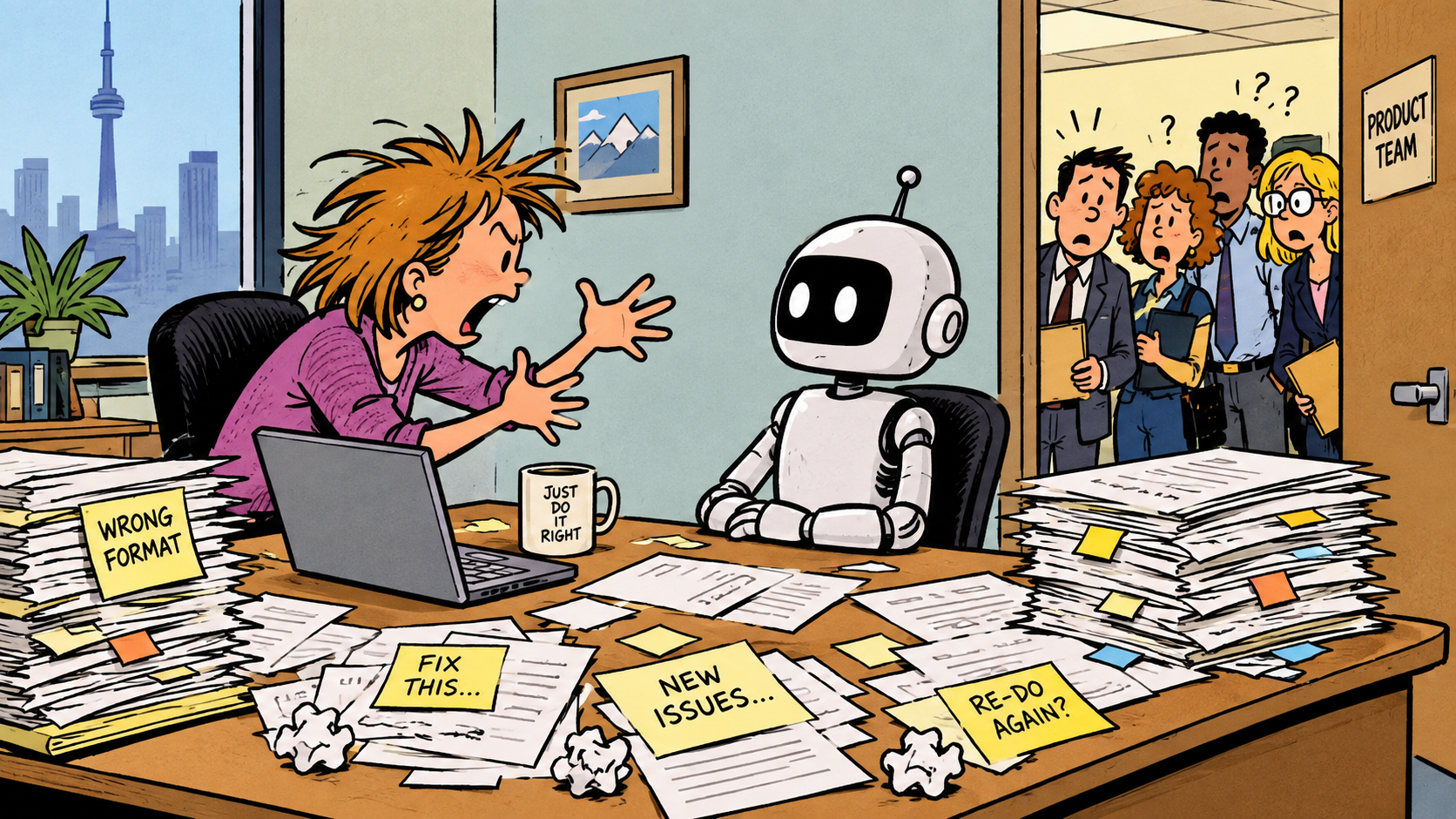
The modern product backlog is under siege by mandate. Enterprise and mid-market leaders are told to inject intelligence into every workflow, automate every touchpoint, and ship AI-native experiences yesterday.Sounds fancy and exciting, YES, but that excitement without proper readiness analysis sets you up for failure on day one. Across boardrooms and sprint reviews, the core dilemma is unresolved: How do you separate an AI feature that actually grows your business from an expensive science experiment?

This framework exists to answer that question. Just because a model is technically impressive doesn't mean users will adopt it—or that it will make your business a single dollar. By anchoring your rollout in Human-Centered AI (HCAI), we stop confusing raw AI capability with actual business success.

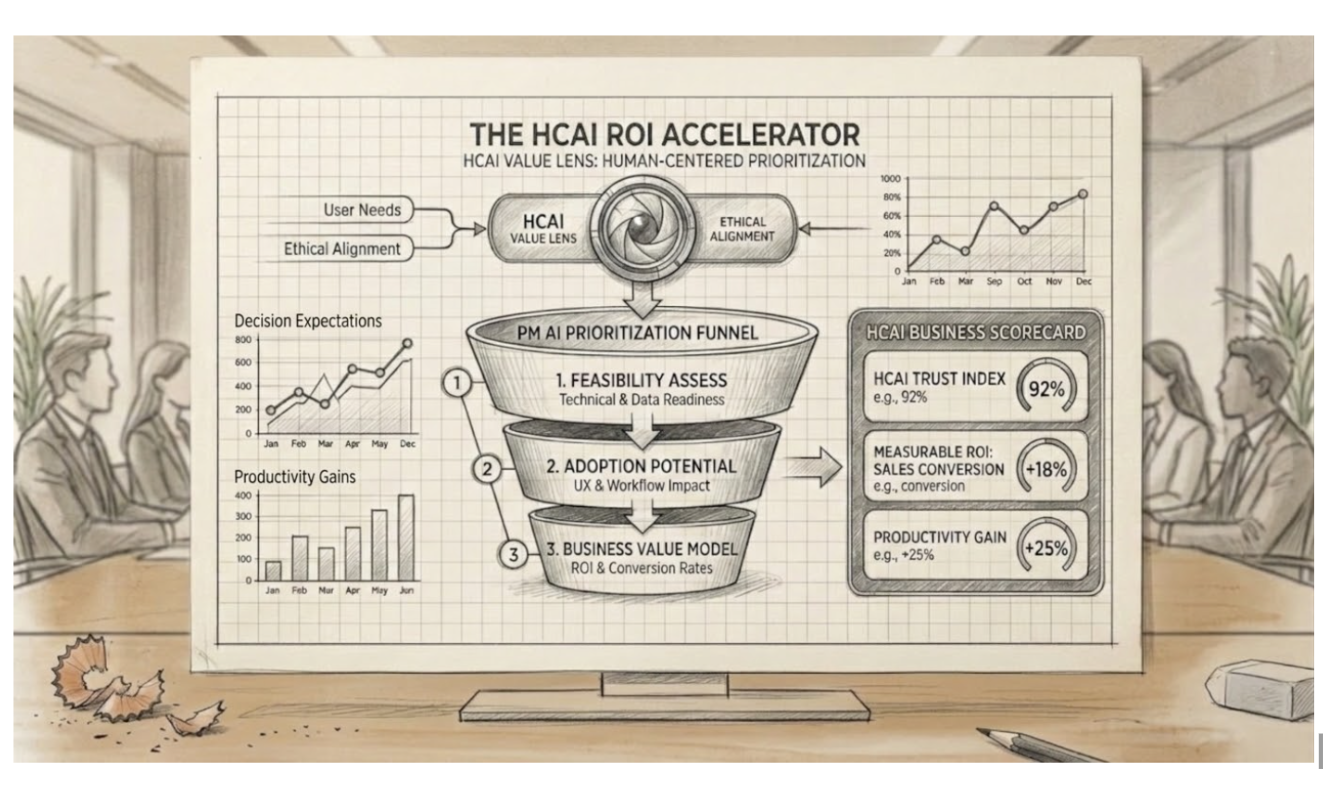
Through this framework, before committing engineering bandwidth or compute budgets, product leaders navigate three structural gates:

  • Organizational Readiness, Infrastructure & The Trust Index: Raw model performance means nothing if your underlying data infrastructure, pipelines, and security layers cannot handle real-time context. Evaluating your enterprise readiness requires scoring an internal AI Readiness Quotient (ARQ) alongside an HCAI Trust Index. The Trust Index tests whether operators trust the outputs, establishes a safe environment for on-the-job upskilling without denting daily productivity, and calibrates a paced speed of adoption—preventing cultural rejection of non-deterministic tooling.
  • Workflow & UX Architecture: Most failed migrations stumble by grafting conversational wrappers onto fragmented workflows. An AI-first workflow is not an isolated chatbot pinned to a legacy dashboard. Auditing UX readiness ensures the implementation genuinely reduces the user's Core Job-to-be-Done (JTBD) instead of introducing cognitive friction. It demands explainable decision pathways (XAI) and design patterns where human judgment and algorithmic execution work synchronously.
  • The Unit Economics of Value: Technical feasibility is vanity without a defensible business model. In an AI-first paradigm, ROI isn’t merely tracked in hypothetical hours saved; it reflects in customer retention, increased conversion rates, minimized false positives, and lower churn. If a feature boosts algorithmic precision but degrades operational trust or NPS, the net return is negative.

True product leadership in this era isn't about deploying the largest model. It is about running a disciplined, repeatable prioritization funnel that turns high-stakes AI journeys into measurable, defensible human and enterprise impact.

Who Am I to Tell You How to Build with AI?‍

Fair question. In an industry overrun by overnight AI experts and glorified API wrappers, healthy skepticism is essential product instinct. Think of me less like the architect pitching the grand vision of Westworld, and more like the engineer stuck in the maintenance tunnels cleaning up after the host breaks down.
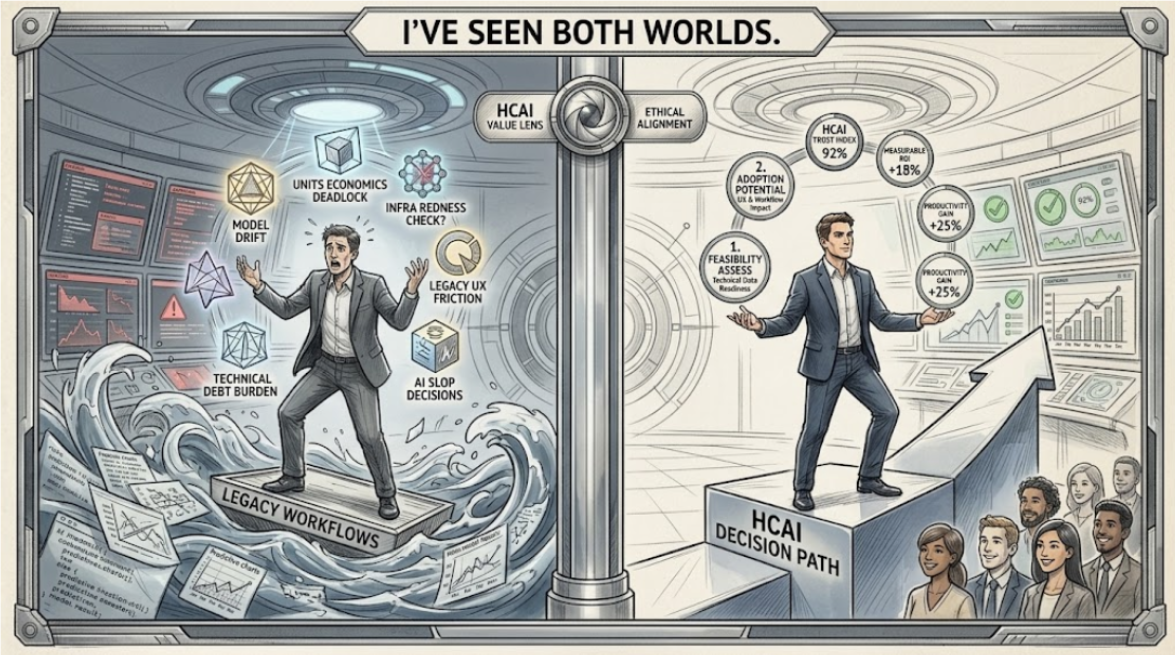
I’ve spent the last 8+ years designing, shipping, and scaling AI products—building in this space long before generative models became executive board fodder and hype cycles took over sprint reviews.

My career has lived in the trenches of both agile scale-ups and complex enterprise environments. That dual vantage point gave me a front-row seat to what separates high-margin AI adoption from million-dollar technical debt. I’ve seen implementations drive runaway user adoption, and I’ve watched technically brilliant models crash and burn at scale because leadership misjudged infrastructure readiness, bungled internal upskilling, or forced non-deterministic intelligence into brittle legacy UX.

This framework isn’t theoretical consultancy; it is the battle-tested scar tissue of shipping in the real world—distilling how leadership choices, data foundations, and human workflows must align to deliver durable enterprise value.

Organizational Readiness, Infrastructure & The Trust Index

Before evaluating algorithms or compute tiers, product leaders should diagnose whether the enterprise host is even capable of accepting the transplant.

The AI Readiness Quotient (ARQ) serves as an objective, multi-dimensional diagnostic to evaluate if your infrastructure, data hygiene, operating culture, and cross-functional processes can sustain non-deterministic systems without stalling delivery pipelines or burning capital.
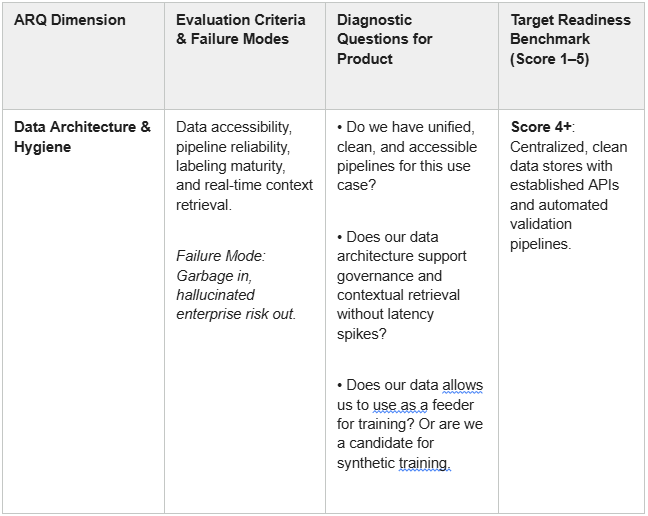
Scoring Your ARQ

  • Total Score < 12 (High Operational Fragility): Stop. Rushing an AI initiative here creates expensive technical debt and organizational backlash. Focus first on modernizing data stores, cleaning core APIs, and training teams on probabilistic workflows before introducing automated intelligence.
  • Total Score 13–19 (Constrained Feasibility): Proceed with hybrid architectures or targeted pilot use cases. Keep humans firmly in the loop to compensate for infrastructural gaps, prioritizing narrow operational pain points rather than customer-facing autonomous loops.
  • Total Score 20–25 (Enterprise Prime): Full-funnel migration ready. The organization possesses the operational maturity to deploy, iterate, and scale autonomous and augmentative models with minimal risk of system rejection.

From Scorecards to Shipping: The Technical Reality Check and the Human Filter 

Once you have your AI Readiness Quotient (ARQ) scored, you hold an honest baseline of your organizational health. If your org has earned a score that clears the threshold (13+ for targeted pilots, 20+ for end-to-end rollouts), you are in a position to evaluate the specific problem space.

Passing organizational readiness does not grant blanket permission to sprinkle machine learning across your roadmap. Instead, it triggers two sequential product filters: Technical & Data Feasibility followed by Human-Centered Adoption Architecture.

‍

Step 1: The Technical & Data Feasibility Filter

A high-performing model built on fragile data infrastructure is an operational liability. Before writing engineering specs or evaluating model providers, test your initiative against three technical reality checks:

  1. The "AI vs. Core Modernization" Decision: Start by answering the foundational question: Do we actually need probabilistic intelligence here? 
    • If customer drop-off is driven by confusing navigation, slow page loads, or fragmented database calls, deploying a generative assistant is wasteful. If a deterministic rules engine or a focused UI refresh solves the problem with 100% predictability and near-zero marginal latency, choose modernization over AI every time. Reserve AI strictly for non-linear problems—such as unstructured data interpretation, contextual recommendations, or dynamic pattern recognition.
  2. Data Readiness & Provenance Audit: Evaluate whether your proprietary data is actually accessible, clean, and contextually rich.
    • Access & Latency: Can your systems retrieve domain-specific data in real time without unacceptable latency spikes?
    • Data Hygiene & Cold Starts: Do you have high-volume historical logs to ground models, or will you face immediate cold-start challenges?
    • Context vs. Fine-Tuning: Determine whether your use case requires fine-tuning an internal model on enterprise data, or if an external foundational model augmented by Retrieval-Augmented Generation (RAG) is sufficient. If internal data is scarce, evaluate whether synthetic data generation is viable and legally compliant.
  3. Architectural Boundaries (Build vs. Buy vs. Partner): Assess whether integrating third-party APIs risks vendor lock-in or leaks sensitive enterprise intellectual property. If proprietary data represents your primary competitive moat, running fine-tuned models within dedicated private environments or utilizing trusted enterprise platforms is mandatory.

Step 2: Jobs-to-be-Done (JTBD) & Human Augmentation

The most catastrophic AI failures occur when product teams attempt to automate the entire outcome rather than augmenting the human carrying out the workflow.

To align an AI initiative with your user's Core JTBD, map the workflow across its cognitive components:

  • Deconstruct the Workflow: Break the user's task down into 
    • Data Retrieval
    • Synthesis & Drafting
    • Critical Evaluation
    • Final Execution.
  • Automate the Tedium, Not the Responsibility: Direct your AI models to ingest messy inputs, summarize historical context, or generate draft options. Leave strategic evaluation, approval, and downstream accountability in the hands of the operator.
  • Reduce Cognitive Load, Don't Displace It: An AI integration that forces an operator to spend 10 minutes fact-checking every word of a generated response has not increased productivity; it has merely converted an active creator into an exhausted proofreader.

Step 3: Determining Where Human-in-the-Loop (HITL) Is Non-Negotiable

Determining whether an interaction requires strict human supervision hinges on two variables: Decision Stakes and Uncertainty & Risk.

‍

Use this decision rubric to structure system intervention:

When to Implement Strict HITL (Human Confirms First):

  • High Financial, Medical, or Legal Impact: In diagnostics, credit underwriting, or automated contract changes, never allow unsupervised system execution (again, depends on how confident you are on your model hypertuning and context aware data feeds)
  • Low Confidence Thresholds: If an inference engine's confidence score drops below your production threshold, the workflow must automatically reroute to human escalation.
  • High Irreversibility: If the user cannot easily undo an action (such as deleting data, triggering public communication, or transferring funds), require explicit human sign-off.

When to Automate Autonomously (Passive Review):

  • Low Risk & High Reversibility: Actions such as Internal categorization, preliminary content tagging, or drafting search query variations.
  • Direct Feedback Loops: Workflows where end-users can adjust or override suggestions without downstream system failure.

Step 4: The Core UX Parameters for AI Adoption

Traditional product UX assumes deterministic outcomes: click A, expect B. AI interactions are probabilistic. If your product experience does not explicitly guide users through ambiguity, user churn and operational rejection will follow.

Consider these four UX parameters before shipping:

  1. Move Beyond the Tacked-On Chatbox: Treating every generative AI implementation as a floating conversational chatbot creates disjointed user journeys. Instead, embed contextual, inline affordances directly inside existing workflows—such as proactive auto-completions, contextual smart highlights, side-by-side comparative diffs, and real-time smart filters.
  2. Explainability & Verification Affordances (XAI): Users will not act on intelligence they cannot rationalize. Every prediction or generated summary must surface provenance indicators—such as clickable citation pills, confidence intervals, or concise rationale blurbs explaining why a particular recommendation was generated.
  3. Frictionless Editability: Make machine outputs instantly malleable. Provide one-click inline editing, quick re-prompting toggles, and seamless manual overrides that capture the user's corrective feedback to retrain future models.
  4. Graceful Degradation and System Fallbacks: When the model times out, returns an hallucination, or hits an empty state, the system must fail silently and gracefully. It should drop back to deterministic rules or classic search without breaking user progress or presenting blank error screens.

Once technical feasibility and human-centered interaction patterns are validated, the next step in the funnel is proving financial viability: translating adoption velocity into defensible, bottom-line return on investment.

The AI Triage Matrix: Where to Bet the Budget (and When to Just Build Traditional Software)

After running your initiative through technical feasibility and human-centered adoption filters, you face the core executive question: Where does this bet live on the roadmap, and how do we justify the capital?

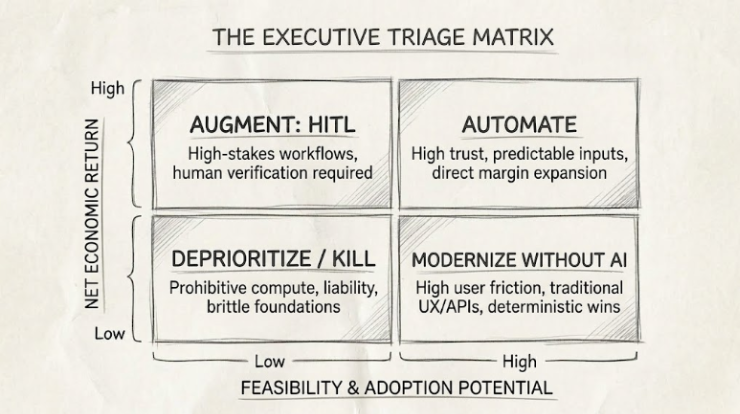
High model accuracy paired with low user trust or prohibitive inference costs leads to negative unit economics. To eliminate subjective roadmap debates, synthesize your readiness score, adoption friction, and economic upside into a clear 2x2 Executive Decision Matrix: mapping Net Economic Return against Adoption & Technical Feasibility.

The Core Equation:

Net AI Margin = (Task Compression Value + Conversion & LTV Lift) - (Token & Compute Costs + Latency Overhead + Human Review Friction)

‍

The Four Strategic Triage Paths

‍

1. Automate (High Feasibility X High Return)

  • The Profile: Clear data provenance, low input ambiguity, high trust tolerance, and deterministic validation paths.
  • Execution Strategy: Deploy direct system execution with passive review. Focus on high-frequency, repeatable tasks where model accuracy exceeds 95% and failure cases carry minimal legal, brand, or financial liability.
  • Business Outcome: Immediate margin recovery, operational task compression, and lower operational overhead.

2. Augment / Human-in-the-Loop (Lower Feasibility X High Return)

  • The Profile: High-value enterprise decisions, unstructured contextual inputs, and severe costs of failure (e.g., medical diagnostics, financial underwriting, contract analysis).
  • Execution Strategy: Do not build autonomous loops. Anchor the architecture around copilots, inline recommendations, and mandatory human checkpoints. The system synthesizes, drafts, and highlights anomalies; the domain expert verifies and executes.
  • Business Outcome: Elevated decision velocity, significant reduction in false positives, and improved customer confidence without exposing the business to model liability.

3. Modernize Without AI (High Feasibility X Low/Marginal AI-Specific Return)

  • The Profile: Severe workflow bottlenecks where the root issue is poor UX architecture, legacy database latency, or broken process hygiene—not a lack of machine intelligence.
  • Execution Strategy: Enforce technical discipline and reject generative AI additions. Solve the problem through standard API refactoring, workflow orchestration, or intuitive interface redesigns. Deterministic software is cheaper to build, virtually free to run, and fails predictably.
  • Business Outcome: Solves the core user Job-to-be-Done (JTBD) at a fraction of the cost, preserving engineering bandwidth and compute budgets for true machine learning differentiators.

4. Deprioritize / Kill (Low Feasibility X Low Return)

  • The Profile: AI initiatives born out of competitive FOMO, vague executive directives, or fragile proof-of-concepts that cannot survive production context.
  • Execution Strategy: Kill the project immediately. Low data hygiene, brittle third-party dependencies, unpredictable inference costs, and ambiguous user value will quickly turn this into technical debt.
  • Business Outcome: Capital preservation. Saying "no" early protects margins and keeps the team focused on core growth drivers.

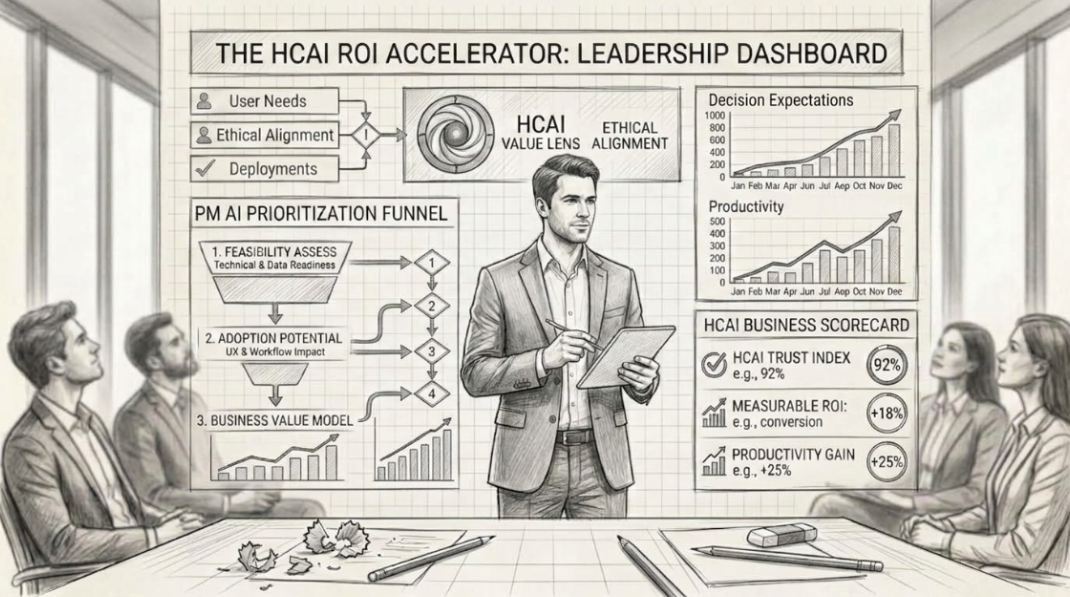
The Product Decision Scorecard

Before signing off on an AI product requirement document (PRD), score the initiative against this lightweight rubric:

‍

Conclusion & The Product Leader’s Monday Morning Checklist

The mandate to ship AI is loud, but the responsibility to deliver sustainable margins is louder. When you strip away the demo dazzle and vendor hyperbole, shipping successful AI products isn’t about chasing peak model parameters—it is about orchestrating human capability, technical reality, and unit economics into a durable feedback loop.

Armed with the AI Readiness Quotient (ARQ), the Technical Feasibility Analysis, and the Executive Triage Matrix, you no longer have to react defensively to executive pressure or engineering proofs-of-concept. You have a repeatable filter to separate genuine enterprise value from expensive technical vanity.

Here’s a real example of how some of this came to use (ofc I can’t name the company here, but it’s a retailer with big blue stores 😛):

The Product Leader’s Monday Morning Checklist

Before you approve the next AI initiative, commit compute budget, or greenlight a Product Requirement Document (PRD), run it through these five non-negotiable questions:

  1. The ARQ Baseline: Does our data infrastructure and operational readiness score high enough to sustain this workflow without creating a swamp of unverified outputs?
  2. The Non-AI Alternative: Can we achieve 80% of this outcome with deterministic APIs, better UX, or workflow orchestration at one-tenth the operational cost?
  3. The JTBD Reduction: Does this model genuinely eliminate cognitive drudgery from the user's workflow, or did we just make them an exhausted proofreader for probabilistic outputs?
  4. The Intervention Threshold: Have we clearly defined where Human-in-the-Loop is mandatory, and built graceful system fallbacks when confidence dips below production thresholds?
  5. The Margin Equation: Will the conversion uplift, task compression, or churn reduction clearly outpace token inference costs, data maintenance, and model drift within two quarters?

If an initiative can’t pass these five checks, have the conviction to table it, refactor it, or kill it early. Automate the work, not the thinking—and build products that drive real enterprise impact and not just bot likes on Linkedin.

What you get as a TPMA Member

Mentorship program and in-person event experiences are at an extra cost.

Join for free!
  • Join the TPMA Slack Community with 1000+ members

  • Free Virtual TPMA events for the entire TPMA Season

  • Become the first to know about in-person events and networking opportunities

Don't Just Build AI Because You Can: A Framework for Yes/No High Stakes AI Bets

October 13, 2026

Preface: Don’t start your AI journey with AI hype‍

The modern product backlog is under siege by mandate. Enterprise and mid-market leaders are told to inject intelligence into every workflow, automate every touchpoint, and ship AI-native experiences yesterday.Sounds fancy and exciting, YES, but that excitement without proper readiness analysis sets you up for failure on day one. Across boardrooms and sprint reviews, the core dilemma is unresolved: How do you separate an AI feature that actually grows your business from an expensive science experiment?

This framework exists to answer that question. Just because a model is technically impressive doesn't mean users will adopt it—or that it will make your business a single dollar. By anchoring your rollout in Human-Centered AI (HCAI), we stop confusing raw AI capability with actual business success.

Through this framework, before committing engineering bandwidth or compute budgets, product leaders navigate three structural gates:

True product leadership in this era isn't about deploying the largest model. It is about running a disciplined, repeatable prioritization funnel that turns high-stakes AI journeys into measurable, defensible human and enterprise impact.

Who Am I to Tell You How to Build with AI?‍

Fair question. In an industry overrun by overnight AI experts and glorified API wrappers, healthy skepticism is essential product instinct. Think of me less like the architect pitching the grand vision of Westworld, and more like the engineer stuck in the maintenance tunnels cleaning up after the host breaks down.

I’ve spent the last 8+ years designing, shipping, and scaling AI products—building in this space long before generative models became executive board fodder and hype cycles took over sprint reviews.

My career has lived in the trenches of both agile scale-ups and complex enterprise environments. That dual vantage point gave me a front-row seat to what separates high-margin AI adoption from million-dollar technical debt. I’ve seen implementations drive runaway user adoption, and I’ve watched technically brilliant models crash and burn at scale because leadership misjudged infrastructure readiness, bungled internal upskilling, or forced non-deterministic intelligence into brittle legacy UX.

This framework isn’t theoretical consultancy; it is the battle-tested scar tissue of shipping in the real world—distilling how leadership choices, data foundations, and human workflows must align to deliver durable enterprise value.

Organizational Readiness, Infrastructure & The Trust Index

Before evaluating algorithms or compute tiers, product leaders should diagnose whether the enterprise host is even capable of accepting the transplant.

The AI Readiness Quotient (ARQ) serves as an objective, multi-dimensional diagnostic to evaluate if your infrastructure, data hygiene, operating culture, and cross-functional processes can sustain non-deterministic systems without stalling delivery pipelines or burning capital.
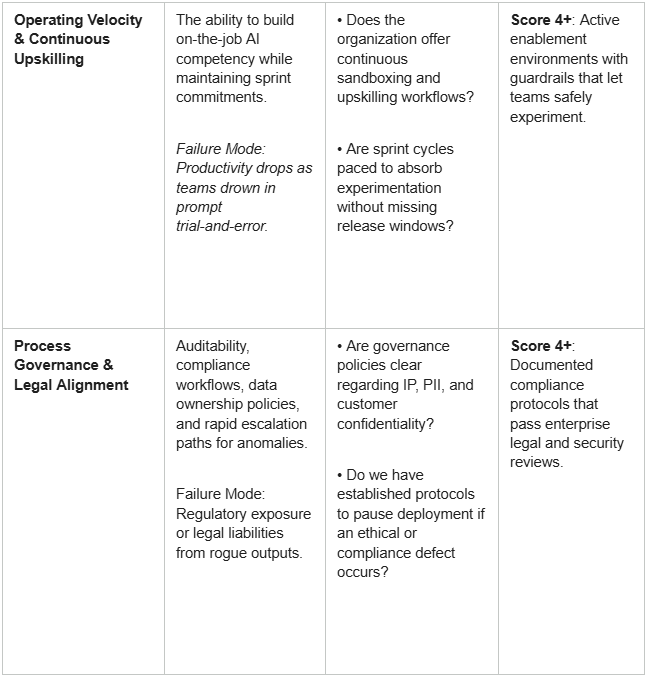
Scoring Your ARQ

From Scorecards to Shipping: The Technical Reality Check and the Human Filter 

Once you have your AI Readiness Quotient (ARQ) scored, you hold an honest baseline of your organizational health. If your org has earned a score that clears the threshold (13+ for targeted pilots, 20+ for end-to-end rollouts), you are in a position to evaluate the specific problem space.

Passing organizational readiness does not grant blanket permission to sprinkle machine learning across your roadmap. Instead, it triggers two sequential product filters: Technical & Data Feasibility followed by Human-Centered Adoption Architecture.

‍

Step 1: The Technical & Data Feasibility Filter

A high-performing model built on fragile data infrastructure is an operational liability. Before writing engineering specs or evaluating model providers, test your initiative against three technical reality checks:

  1. The "AI vs. Core Modernization" Decision: Start by answering the foundational question: Do we actually need probabilistic intelligence here? 
    • If customer drop-off is driven by confusing navigation, slow page loads, or fragmented database calls, deploying a generative assistant is wasteful. If a deterministic rules engine or a focused UI refresh solves the problem with 100% predictability and near-zero marginal latency, choose modernization over AI every time. Reserve AI strictly for non-linear problems—such as unstructured data interpretation, contextual recommendations, or dynamic pattern recognition.
  2. Data Readiness & Provenance Audit: Evaluate whether your proprietary data is actually accessible, clean, and contextually rich.
    • Access & Latency: Can your systems retrieve domain-specific data in real time without unacceptable latency spikes?
    • Data Hygiene & Cold Starts: Do you have high-volume historical logs to ground models, or will you face immediate cold-start challenges?
    • Context vs. Fine-Tuning: Determine whether your use case requires fine-tuning an internal model on enterprise data, or if an external foundational model augmented by Retrieval-Augmented Generation (RAG) is sufficient. If internal data is scarce, evaluate whether synthetic data generation is viable and legally compliant.
  3. Architectural Boundaries (Build vs. Buy vs. Partner): Assess whether integrating third-party APIs risks vendor lock-in or leaks sensitive enterprise intellectual property. If proprietary data represents your primary competitive moat, running fine-tuned models within dedicated private environments or utilizing trusted enterprise platforms is mandatory.

Step 2: Jobs-to-be-Done (JTBD) & Human Augmentation

The most catastrophic AI failures occur when product teams attempt to automate the entire outcome rather than augmenting the human carrying out the workflow.

To align an AI initiative with your user's Core JTBD, map the workflow across its cognitive components:

Step 3: Determining Where Human-in-the-Loop (HITL) Is Non-Negotiable

Determining whether an interaction requires strict human supervision hinges on two variables: Decision Stakes and Uncertainty & Risk.

‍

Use this decision rubric to structure system intervention:

When to Implement Strict HITL (Human Confirms First):

When to Automate Autonomously (Passive Review):

Step 4: The Core UX Parameters for AI Adoption

Traditional product UX assumes deterministic outcomes: click A, expect B. AI interactions are probabilistic. If your product experience does not explicitly guide users through ambiguity, user churn and operational rejection will follow.

Consider these four UX parameters before shipping:

  1. Move Beyond the Tacked-On Chatbox: Treating every generative AI implementation as a floating conversational chatbot creates disjointed user journeys. Instead, embed contextual, inline affordances directly inside existing workflows—such as proactive auto-completions, contextual smart highlights, side-by-side comparative diffs, and real-time smart filters.
  2. Explainability & Verification Affordances (XAI): Users will not act on intelligence they cannot rationalize. Every prediction or generated summary must surface provenance indicators—such as clickable citation pills, confidence intervals, or concise rationale blurbs explaining why a particular recommendation was generated.
  3. Frictionless Editability: Make machine outputs instantly malleable. Provide one-click inline editing, quick re-prompting toggles, and seamless manual overrides that capture the user's corrective feedback to retrain future models.
  4. Graceful Degradation and System Fallbacks: When the model times out, returns an hallucination, or hits an empty state, the system must fail silently and gracefully. It should drop back to deterministic rules or classic search without breaking user progress or presenting blank error screens.

Once technical feasibility and human-centered interaction patterns are validated, the next step in the funnel is proving financial viability: translating adoption velocity into defensible, bottom-line return on investment.

The AI Triage Matrix: Where to Bet the Budget (and When to Just Build Traditional Software)

After running your initiative through technical feasibility and human-centered adoption filters, you face the core executive question: Where does this bet live on the roadmap, and how do we justify the capital?

High model accuracy paired with low user trust or prohibitive inference costs leads to negative unit economics. To eliminate subjective roadmap debates, synthesize your readiness score, adoption friction, and economic upside into a clear 2x2 Executive Decision Matrix: mapping Net Economic Return against Adoption & Technical Feasibility.

The Core Equation:

Net AI Margin = (Task Compression Value + Conversion & LTV Lift) - (Token & Compute Costs + Latency Overhead + Human Review Friction)
‍

The Four Strategic Triage Paths

‍

1. Automate (High Feasibility X High Return)

2. Augment / Human-in-the-Loop (Lower Feasibility X High Return)

3. Modernize Without AI (High Feasibility X Low/Marginal AI-Specific Return)

4. Deprioritize / Kill (Low Feasibility X Low Return)

The Product Decision Scorecard

Before signing off on an AI product requirement document (PRD), score the initiative against this lightweight rubric:

‍

Conclusion & The Product Leader’s Monday Morning Checklist

The mandate to ship AI is loud, but the responsibility to deliver sustainable margins is louder. When you strip away the demo dazzle and vendor hyperbole, shipping successful AI products isn’t about chasing peak model parameters—it is about orchestrating human capability, technical reality, and unit economics into a durable feedback loop.

Armed with the AI Readiness Quotient (ARQ), the Technical Feasibility Analysis, and the Executive Triage Matrix, you no longer have to react defensively to executive pressure or engineering proofs-of-concept. You have a repeatable filter to separate genuine enterprise value from expensive technical vanity.

Here’s a real example of how some of this came to use (ofc I can’t name the company here, but it’s a retailer with big blue stores 😛):

The Product Leader’s Monday Morning Checklist

Before you approve the next AI initiative, commit compute budget, or greenlight a Product Requirement Document (PRD), run it through these five non-negotiable questions:

  1. The ARQ Baseline: Does our data infrastructure and operational readiness score high enough to sustain this workflow without creating a swamp of unverified outputs?
  2. The Non-AI Alternative: Can we achieve 80% of this outcome with deterministic APIs, better UX, or workflow orchestration at one-tenth the operational cost?
  3. The JTBD Reduction: Does this model genuinely eliminate cognitive drudgery from the user's workflow, or did we just make them an exhausted proofreader for probabilistic outputs?
  4. The Intervention Threshold: Have we clearly defined where Human-in-the-Loop is mandatory, and built graceful system fallbacks when confidence dips below production thresholds?
  5. The Margin Equation: Will the conversion uplift, task compression, or churn reduction clearly outpace token inference costs, data maintenance, and model drift within two quarters?

If an initiative can’t pass these five checks, have the conviction to table it, refactor it, or kill it early. Automate the work, not the thinking—and build products that drive real enterprise impact and not just bot likes on Linkedin.