I don't usually believe that the real world follows clean academic frameworks, least of all in innovation and product strategy. Yet after years of teaching and mentoring founders and product managers, I keep leaning on the same few.
This approach has held up, so I'm finally writing it down.
A couple of years ago I found that five of them can stack on top of each other, and that together they reinforce the message I think is most important.
If you've had the benefit (or punishment!) of sitting in front of me while I give feedback on your product strategy, you know I bring everything back to the value proposition.
Where to put your product effort comes down to these questions:
This all holds for a startup adding to its offering and for a founder with no product yet. It even applies to how you build a pitch deck.
And it’s this deduction of clear, unique value proposition that the five frameworks reinforces, and find in it their intersection.
Start with a model most people who've studied business or product will know: Clayton Christensen's disruptive innovation, set out in The Innovator's Dilemma. It's decades old, and I'm still amazed at how relevant it stays.
In its simplest form:
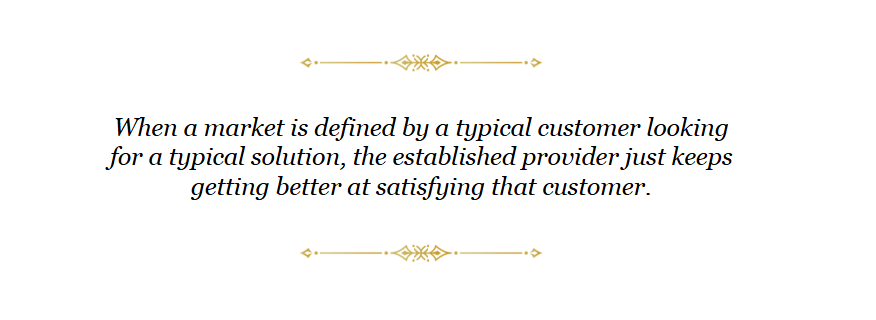
That's a problem for anyone new. You don'thave the customer intimacy, the capital or the brand to beat the incumbent on what the market already measures.
So don't try. Accept that you won't be as good, and offer something slightly different from what the broad marketexpects. Among the people who use this kind of solution, there's a subsegment that is a little dissatisfied, for a reason specific to them. That subsegment is too small for the incumbent to build specifically for.
The disruptor goes to that subsegment and says: we're just for you. We'll get your job done, and give you the specific thing you've been missing.
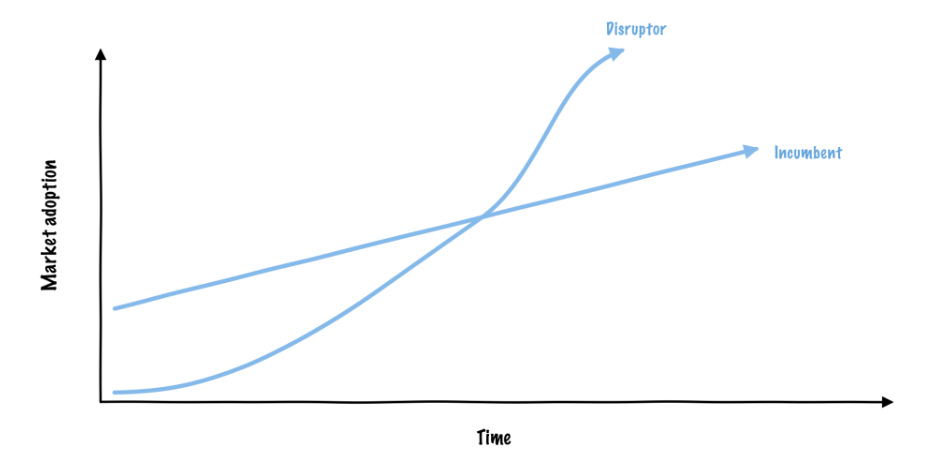
This comes with compromise. Other parts of the experience may not be as performant, at least by conventional wisdom, but the subsegment's priorities are different enough that it accepts the trade.
Here's the bet: You chose this subsegment because you expect it to become the mainstream market of the future, and the point where that happens is where the two lines cross. By then the incumbent is too invested in what it already is, and in what its traditional customers expect, to risk changing. You have much less to lose, and suddenly the advantages and disadvantages have swapped sides.
At the centre of this model sits the assumption that makes innovation exciting in the first place: markets aren't static, and habits and needs change over time.
Example: Easy cloud hosting worked for most tech startups, but when we started MedStack, healthcare startups, representing an early small market, needed something more specific for their privacy solutions.
If disruption tells you how you'll win, then how do you get there? This is where I bring in Geoffrey Moore's chasm model, which still shapes how the innovation world talks, and I think for good reason.
Both models turn on a single inflection point. For Christensen, it's the moment the disruptor's share of the market (or more accurately, market-perceived product performance) rises to match the incumbent's. For Moore, it's the moment you cross the chasm. I think you can lay one directly on top of the other.
Moore describes the chasm as the place where innovations die, running out of operational budget before they find traction beyond the early experimenters. Early adopters are the people most willing to try something new and the hardest to please. The best way across is to get those early adopters using your product with attention and loyalty, keeping you going until the rest of the market takes notice.
Put the other way round, the early adopters are the small subsegment from Layer 1. They'll take a risk on something new because the incumbent leaves them a little wanting.
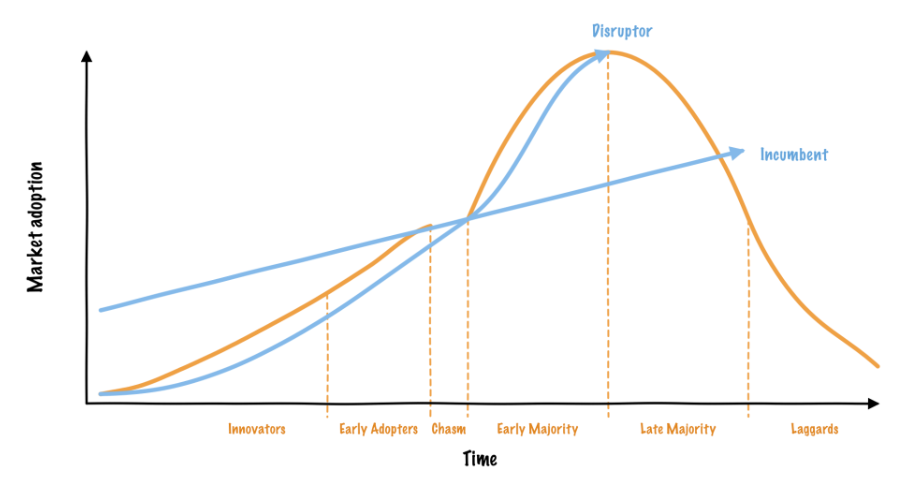
On the far side of that point, the disruptor starts to overtake the incumbent.
Moore calls this stretch “The Tornado”: a period of hypergrowth when everyone is suddenly talking about what you do. Once you're the thing everyone talks about, you command the early majority.
Example: A company I’ve worked with took the idea of a broad marketplace to something specific in packaging for the needs of a narrow segment to introduce a new business model.
The third layer asks what exactly you shouldbuild. Here I call upon the Kano model.
The (simplified) idea behind Kano is that every product has three kinds of features. I love it because it seems to apply to anything you can name, whether it's a piece of software or a service:
● Basic needs: what you must have to be in the market at all - but doing them the“best” doesn’t really move things.
● Performance features: the measurable things customers compare when they choose - the more you have, the better.
● Delighters: the things nobody expected, which come to define who you are in the market - you can sell without them, but it seems you’re missing that “one morething”.
These categories live in the mind of the buyer, though. A whole market may sort them one way and a subsegment another. If so, couldn't the delighter be the one thing the subsegment wanted all along? It's what they felt the incumbent wasn't delivering well enough, or specifically enough, for them. They may value it so much that, at first, they'll compromise on the levels of the other two.
That can't last though. To keep winning in a period of hypergrowth, you have to eventually robustly cover the basic needs. And once customers start comparison shopping, the performance features decide who wins. So each category has its own stretch of the chart where it matters most.

Example: A company I’ve worked with is transforming a healthcare workflow for better scale, and focused initially on specifics of user delight that so far had been reported as irritants and friction to moving the market ahead.
Blue Ocean Strategy, by W. Chan Kim and Renée Mauborgne, in a way expresses the same idea, inviting another layer.
It argues for a mindset: instead of worrying about how you compete, set things up so you aren't competing at all.
At its core, the model asks you to look at how customers add features up into value. Then be willing to give up some of them, so you can define yourself by an experience of feature priority people haven't thought of, even while solving the same problem as everyone else.
Conveniently, that focus is the delighters we just covered. Just as conveniently, you have that conversation with the early adopters, who are willing to look at things in a new way. If it works, tell that story so it carries you over the chasm. Once you're across, a new price-quality equation defines the market, and the old incumbent no longer sets it.
Example: A service offering marketplace with which I worked flipped the typical metrics of competitors into a focus on onboarding and bringing in value elements from two different ends of the market into a new combination.
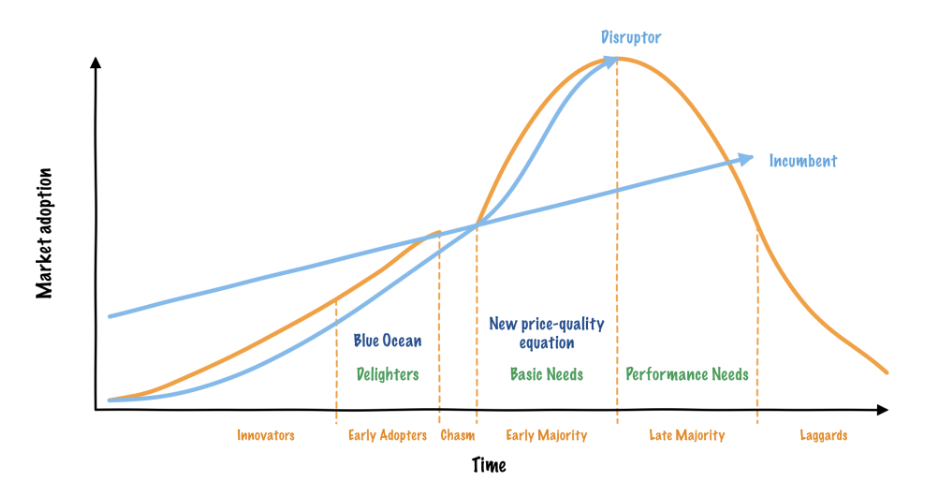
You were probably wondering when I'd get to this: We can't have this conversation without Lean Startup.
There's a reason everyone quotes Eric Ries: he deserves credit for language that now defines how we talk about product and innovation strategy. He has also said the Lean Startup principles still apply, though parts of it play out differently in an economy now driven by AI.
Layering it in is tricky, because the Lean Startup loop isn't tied to a point in time.
That's the key message, in fact: validated learning never stops, and neither does the loop. It's also why the name can mislead. Ries defines a “startup” as an initiative operating in market uncertainty, not by company size.
Still, the key terms fit this picture, and the whole model keeps cycling. For any single offering, the MVP is the focus of your conversation with early adopters. Build the habit of validated learning there and it carries into every conversation that follows a successful early-adopter strategy - as you win one niche, and then the one beside it, the way Moore describes his bowling alley. That's what gets you over the chasm.
From there you need a new way to measure success, which Ries calls “innovation accounting”. I'd even stretch it to the wider accounting for positive human flourishing that hewrites about in his new book, Incorruptible.

Example: Speaking with potential early users and advocates of a coming innovation with a company with which I was working helped us to better understand their current journeys and who actually was involved in every step, thereby changing our intended approach.
And there you have it. (It's a little self-serving and insists upon itself, I'll be the first to admit.)
I frame it this way to push everyone to whom I speak back to the most important conversation: who your customer is, and how they perceive what you're doing next to everything else on the market.
Go back to the six questions at the top. Each layer asks some of them again. Underneath it all, this is a fancier way of talking about innovation relative to competition, and if that's the only thing someone takes away, I'm happy.
I'm sure academics could find plenty wrong or forcibly inaccurate with this framing, as could business leaders much smarter than me, and that's fine. I'd welcome an edit that corrects or expands it.
So tell me: are you building something, at a startup or inside a large enterprise, where you think this approach wouldn't work? I'd love to know why, so I can keep the story useful.
Mentorship program and in-person event experiences are at an extra cost.
Join for free!Join the TPMA Slack Community with 1000+ members
Free Virtual TPMA events for the entire TPMA Season
Become the first to know about in-person events and networking opportunities
I don't usually believe that the real world follows clean academic frameworks, least of all in innovation and product strategy. Yet after years of teaching and mentoring founders and product managers, I keep leaning on the same few.
This approach has held up, so I'm finally writing it down.
A couple of years ago I found that five of them can stack on top of each other, and that together they reinforce the message I think is most important.
If you've had the benefit (or punishment!) of sitting in front of me while I give feedback on your product strategy, you know I bring everything back to the value proposition.
Where to put your product effort comes down to these questions:
This all holds for a startup adding to its offering and for a founder with no product yet. It even applies to how you build a pitch deck.
And it’s this deduction of clear, unique value proposition that the five frameworks reinforces, and find in it their intersection.
Start with a model most people who've studied business or product will know: Clayton Christensen's disruptive innovation, set out in The Innovator's Dilemma. It's decades old, and I'm still amazed at how relevant it stays.
In its simplest form:
That's a problem for anyone new. You don'thave the customer intimacy, the capital or the brand to beat the incumbent on what the market already measures.
So don't try. Accept that you won't be as good, and offer something slightly different from what the broad marketexpects. Among the people who use this kind of solution, there's a subsegment that is a little dissatisfied, for a reason specific to them. That subsegment is too small for the incumbent to build specifically for.
The disruptor goes to that subsegment and says: we're just for you. We'll get your job done, and give you the specific thing you've been missing.
This comes with compromise. Other parts of the experience may not be as performant, at least by conventional wisdom, but the subsegment's priorities are different enough that it accepts the trade.
Here's the bet: You chose this subsegment because you expect it to become the mainstream market of the future, and the point where that happens is where the two lines cross. By then the incumbent is too invested in what it already is, and in what its traditional customers expect, to risk changing. You have much less to lose, and suddenly the advantages and disadvantages have swapped sides.
At the centre of this model sits the assumption that makes innovation exciting in the first place: markets aren't static, and habits and needs change over time.
Example: Easy cloud hosting worked for most tech startups, but when we started MedStack, healthcare startups, representing an early small market, needed something more specific for their privacy solutions.
If disruption tells you how you'll win, then how do you get there? This is where I bring in Geoffrey Moore's chasm model, which still shapes how the innovation world talks, and I think for good reason.
Both models turn on a single inflection point. For Christensen, it's the moment the disruptor's share of the market (or more accurately, market-perceived product performance) rises to match the incumbent's. For Moore, it's the moment you cross the chasm. I think you can lay one directly on top of the other.
Moore describes the chasm as the place where innovations die, running out of operational budget before they find traction beyond the early experimenters. Early adopters are the people most willing to try something new and the hardest to please. The best way across is to get those early adopters using your product with attention and loyalty, keeping you going until the rest of the market takes notice.
Put the other way round, the early adopters are the small subsegment from Layer 1. They'll take a risk on something new because the incumbent leaves them a little wanting.
On the far side of that point, the disruptor starts to overtake the incumbent.
Moore calls this stretch “The Tornado”: a period of hypergrowth when everyone is suddenly talking about what you do. Once you're the thing everyone talks about, you command the early majority.
Example: A company I’ve worked with took the idea of a broad marketplace to something specific in packaging for the needs of a narrow segment to introduce a new business model.
The third layer asks what exactly you shouldbuild. Here I call upon the Kano model.
The (simplified) idea behind Kano is that every product has three kinds of features. I love it because it seems to apply to anything you can name, whether it's a piece of software or a service:
● Basic needs: what you must have to be in the market at all - but doing them the“best” doesn’t really move things.
● Performance features: the measurable things customers compare when they choose - the more you have, the better.
● Delighters: the things nobody expected, which come to define who you are in the market - you can sell without them, but it seems you’re missing that “one morething”.
These categories live in the mind of the buyer, though. A whole market may sort them one way and a subsegment another. If so, couldn't the delighter be the one thing the subsegment wanted all along? It's what they felt the incumbent wasn't delivering well enough, or specifically enough, for them. They may value it so much that, at first, they'll compromise on the levels of the other two.
That can't last though. To keep winning in a period of hypergrowth, you have to eventually robustly cover the basic needs. And once customers start comparison shopping, the performance features decide who wins. So each category has its own stretch of the chart where it matters most.
Example: A company I’ve worked with is transforming a healthcare workflow for better scale, and focused initially on specifics of user delight that so far had been reported as irritants and friction to moving the market ahead.
Blue Ocean Strategy, by W. Chan Kim and Renée Mauborgne, in a way expresses the same idea, inviting another layer.
It argues for a mindset: instead of worrying about how you compete, set things up so you aren't competing at all.
At its core, the model asks you to look at how customers add features up into value. Then be willing to give up some of them, so you can define yourself by an experience of feature priority people haven't thought of, even while solving the same problem as everyone else.
Conveniently, that focus is the delighters we just covered. Just as conveniently, you have that conversation with the early adopters, who are willing to look at things in a new way. If it works, tell that story so it carries you over the chasm. Once you're across, a new price-quality equation defines the market, and the old incumbent no longer sets it.
Example: A service offering marketplace with which I worked flipped the typical metrics of competitors into a focus on onboarding and bringing in value elements from two different ends of the market into a new combination.
You were probably wondering when I'd get to this: We can't have this conversation without Lean Startup.
There's a reason everyone quotes Eric Ries: he deserves credit for language that now defines how we talk about product and innovation strategy. He has also said the Lean Startup principles still apply, though parts of it play out differently in an economy now driven by AI.
Layering it in is tricky, because the Lean Startup loop isn't tied to a point in time.
That's the key message, in fact: validated learning never stops, and neither does the loop. It's also why the name can mislead. Ries defines a “startup” as an initiative operating in market uncertainty, not by company size.
Still, the key terms fit this picture, and the whole model keeps cycling. For any single offering, the MVP is the focus of your conversation with early adopters. Build the habit of validated learning there and it carries into every conversation that follows a successful early-adopter strategy - as you win one niche, and then the one beside it, the way Moore describes his bowling alley. That's what gets you over the chasm.
From there you need a new way to measure success, which Ries calls “innovation accounting”. I'd even stretch it to the wider accounting for positive human flourishing that hewrites about in his new book, Incorruptible.
Example: Speaking with potential early users and advocates of a coming innovation with a company with which I was working helped us to better understand their current journeys and who actually was involved in every step, thereby changing our intended approach.
And there you have it. (It's a little self-serving and insists upon itself, I'll be the first to admit.)
I frame it this way to push everyone to whom I speak back to the most important conversation: who your customer is, and how they perceive what you're doing next to everything else on the market.
Go back to the six questions at the top. Each layer asks some of them again. Underneath it all, this is a fancier way of talking about innovation relative to competition, and if that's the only thing someone takes away, I'm happy.
I'm sure academics could find plenty wrong or forcibly inaccurate with this framing, as could business leaders much smarter than me, and that's fine. I'd welcome an edit that corrects or expands it.
So tell me: are you building something, at a startup or inside a large enterprise, where you think this approach wouldn't work? I'd love to know why, so I can keep the story useful.
Toronto Product Management Association (TPMA) is a community focused on development, growth and networking of Product professionals in the Greater Toronto Area.
.jpeg)