The Fall Product Mentorship Program is Open! Mentors and Mentees apply by Sept 24!

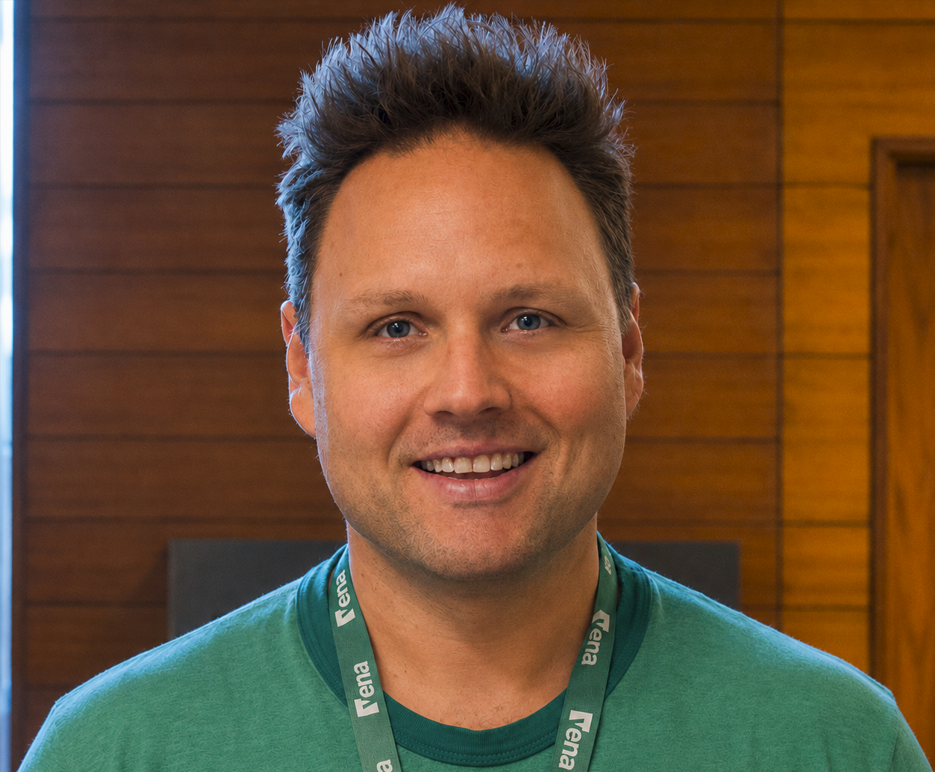
What does it actually take to reach the top of product management and stay there? For Andrew Stanbridge, SVP of Product at Vena Solutions, the answer has less to do with roadmaps and frameworks than most PMs would expect. Over nearly two decades in B2B SaaS, through companies like Eloqua, Achievers, and Collage HR, Andrew has navigated IPOs, acquisitions, and the kind of high-stakes decisions that define careers. In this edition of Product Star Spotlight, he shares the lessons that shaped him; on pricing, GTM, leadership, and on why product management is, at its core, a decision-making profession.
--
Pivot Point #1
The first was actually something I didn't do.
I was working in Premier Support at Eloqua and the Director of Marketing Ops wanted me to apply for a role to own the use of our own product. When I met with my boss to tell him I planned to apply, he asked me a question that stuck with me:
“Are you going after this role because it’s your calling, or just because it’s an opportunity?”
He told me to think about it over the weekend, because the next move I made would likely set the path for the rest of my career.
Over the weekend, I realized a career in marketing ops didn't actually excite me. What excited me was the idea of a new role and more money. So I went back in on Monday and told my boss I wasn't applying. Not long after, the folks on the product management team started asking me what our customers wanted to see changed in the product. That was my first peek into Product, and after a short period of time with that team, I knew it was what I wanted to do.
I waited for the next opening, applied, and transitioned into product management. In hindsight I realized this was one of the best examples of mentorship in action I’d experienced in my career and without it might not have found my professional calling.
Pivot Point #2
The second was a former colleague who asked me to do some product consulting for the company she worked at. Initially I wasn't interested in doing it for free, but ultimately decided it was a good opportunity to network and gain PM consulting experience.
That same woman later introduced me to the co-founder and CTO of Vena for a similar engagement, which is ultimately what led to me joining Vena. If I'd turned down that free consulting gig, I likely wouldn't be where I am today.
Pivot Point #3
The third was every liquidity event I've been part of. It's the ultimate milestone for a tech company, and something I came to realize later: having that experience under your belt is some of the most valuable career currency you can have. I think this is particularly important today in a world where average tenure has plummeted. You have to have really been a part of the company's liquidity journey to earn the “currency”.
First off, a proven ability to deliver and drive outcomes are prerequisites, not what actually differentiates you as you climb the seniority ladder.
Beyond that, it comes down to a few things:
There’s a lot of literature on this topic so I’ll just share a few learnings from my own experience.
Early Stage Startups
When you are a PM at a small start up, you wear many hats including customer success, support, implementation, design, and more. It’s obviously a lot of work but the benefit is getting super close to the customer and the day-to-day mechanics of the business. It gives you a depth of insight that's hard to replicate once those functions become specialized and separated from Product.
Scaling Up & Growing
As you scale, it's really hard to get the timing of hiring and new processes correct. Wait too long to hire, you cripple growth or burn out. Hire too quickly and you become inefficient. I love Brian Chesky's observation that every new person added to a team creates a hidden "communication tax" (extra meetings, emails, and admin overhead).
It always amazes me how many people obsess over designing the perfect process for every possible permutation, when that's often a poor use of time and energy. My own motto is "just enough process." There’s no exact science to this and my lesson learned is it’s amazing how easily you get caught up in the immediate horizon work. You need to consciously be taking a step back from the daily grind on a quarterly basis to assess team size, structure and processes.
Larger Companies
Product at larger companies typically pays the best but you will deal with two challenges.
The first is velocity – that communication tax I mentioned becomes real and you're constantly fighting to try and deliver product outcomes faster.
The second is you become removed from actually using your product. This is particularly true in product leadership but the business of product becomes more front and centre and it's very easy to lose your ability to actually demo, use and understand the details of how your users use your product. What happens naturally at start ups which is being in your product every day becomes something you have to consciously practice.
You've got to believe the company will be successful.
I see so many people excited to just get an offer, they don’t really look at the company they are joining. You need to Interview the company, and the market they play in, not just let the company interview you. Do you believe in their products, strategy, leadership?
The more senior you get the more in depth you should be getting into the business. For example asking about how they budget for Product; is it remaining flat as a percent of revenue? What’s their EBITDA? Are they hemorrhaging cash? Etc.
Educate yourself on equity.
Understand the differences between RSU’s, stock options, vesting periods, strike prices etc. Are you joining a public company where the stock price is public or a private company where it's pegged to a fund raising event?
A common pitfall I see is people looking to join private companies where recruiters dangle stock options as part of a total compensation package. They’ll say your total compensation is $200K. It has a $125K base and $75K options. When joining a company I advise people to make the decision assuming the options are worth nothing as it’s a lottery ticket with slightly better odds. The more you believe in the company, the more you personally can weigh asking for more stock options vs base salary.
I’ve been through liquidity events where the options ended up being worth $0 and others where they were worth far more than my strike price. It's largely out of your control and very hard to predict. A general rule of thumb is the longer a company has been around, the less likely it is your options will eventually be worth anything.
The 18 Month Allure
A liquidity event is never certain until it actually happens and the money is deposited into your account. I remember being at Eloqua and people saying, “we’re going public in 18 months”. We eventually did go public but several years after that hype started. On the first day at my next company a dev manager said, “you joined the right company, we’re going public in 18 months”. It never happened. Why 18 months? I’ve now learned that telling employees there will be a liquidity event in 18 months is close enough that it’s engaging for employees but far enough away that it’s not distracting to current fiscal year objectives.
Like I mentioned earlier, meaningfully being a part of one is massive career currency. The reason is executives and investors love hiring people who have that experience. Everyone talks about learning from failure and you certainly can. However if you fail at a start up, all you know is what to do or not do up to the point of scale where it failed. If you’ve been through a liquidity event you have the experience at every step of that journey. I can confidently say that my experience through liquidity events accelerated my career path at every level of Product.
Willingness to pay is the ultimate test of whether you've built something people actually value.
It's easy to feel good about a feature when it's free because you don't have to defend it. But when you charge for it, you can't hide behind documentation. You have to stand up and articulate why this is worth paying for.
What makes pricing hard yet fascinating is that it's part science, part psychology.
For example, why does a Nike t-shirt cost 3x an Amazon Essentials t-shirt? Brand, positioning, perceived pain relieved, competitive alternatives don't show up on a spec sheet, but it's all "priced in".
In B2B it gets even more challenging when you need to account for tiering, bundling, volume discounts, whether you segment by SMB/MM/ENT, whether you have transparent pricing, the list goes on. Internally, pricing is one of the most politically charged conversations in a company. Everyone from sales to finance to the CEO has an opinion, and usually a strong one as they are more senior than you.
That's exactly why I love it, if you want to find out whether you truly understand your customer, try pricing something for them!
To be clear, building anything new is genuinely hard, especially right now with agentic coding tools reshaping the development lifecycle faster than most teams can adapt their process to it. But building was never the part that surprised me. What surprised me is that in B2B SaaS, "if you build it, they will come" is a myth.
The hardest part of the job starts after launch, in the GTM engine.
Internally, you're trying to align a whole company around something new. Sales needs new talk tracks, CX needs to know how to support it, marketing needs a story etc., yet none of those people report to you.
That's the core paradox of product management: you have accountability without authority. You can't mandate change, you have to earn it by soliciting buy-in.
Externally, the customer world is busier than ever with every vendor fighting for customer attention. A customer can love your product and your brand and still never give you the 15min to hear about it. The best PM's know how to get scrappy by arming a sales rep with the right one-pager or doing a live demo for a skeptical CX team.
None of that works without strong communication skills and that's where I see a lot of PMs come up short. You can build the best product in the world, but if you can't stand up and “sell it”, tell its story clearly and repeatedly to a dozen different audiences, you will hit a ceiling in your PM career.
Consolidated Roles and Territorial Lines
Right now, AI tools like Figma and Claude Design are causing consolidation between product, design, and engineering faster than most orgs can adapt to capture the benefit.
A practical example of adapting is considering how the role of a Designer shifts from building prototypes to managing their design system as context for AI design tools. Prototypes that used to take days can now be built in a few hours, and that's breaking down the traditional handoff model (i.e., PM writes requirements, design mocks it up, engineering builds it). Teams need to rethink their development lifecycle now, or friction will emerge around old territorial lines. For example, I've already seen designers feel threatened by PMs building their own prototypes. The people who thrive in this shift are the ones who move fluidly across all three disciplines, not the ones guarding a legacy, narrow lane.
And there is a real cost consideration here. Prototyping with real customers and internal stakeholders is dramatically “cheaper” than it's ever been. But we all know the new cost that's emerged is token costs. Teams need to be treating them as a real design constraint, meaning you must be deliberate about how much prototyping depth a feature actually warrants relative to its risk and complexity. Don't just default to prototyping everything.
Visual UX Isn’t Disappearing
I was recently at an event listening to the head of AI at PayPal talk about voice as an emerging interface. Long term, I think he's right, but I don't think voice replaces UX; I think it sits alongside it.
For use cases like comparison, complex data review, or exploration, people still benefit from something to look at. But for quick, well-defined commands, voice can eliminate the need for a visual UI entirely and that has real implications for how software gets built. Product will increasingly have to decide, use case by use case, whether the interface should be voice at all, because if it is, there's no front end to design or development.
Less Orchestration, More Judgement
Looking ahead, PMs need to recognize the role itself is being compressed. I'm already seeing PM's transcribe a customer call, paste it into Cursor with spec-kit to generate code, and use Figma Make to generate a prototype. That whole chain from requirements to prototype to code is compressing into hours/minutes. Nobody's going to pay a PM well to copy-paste between tools. What actually matters is making high-quality decisions about what's worth building in the first place, rigorously testing whether the output actually meets the bar before it ships, deeply understanding your customer and domain, and driving the GTM motion once it's out. I think these focus areas are where Product is headed. Ultimately less orchestration, and more judgment.
A few years ago I was at a JMI Equity event listening to Harry Gruner, JMI’s co-founder do a fireside chat about Product and Tech board sessions. The crux of the chat was that investors speak the language of dollars and cents and aren’t familiar with the features and functions of your product. Far too often CTO’s and CPO’s show up to board meetings talking about features and not about commercial outcomes. That learning best summarizes the key to success when communicating with these audiences.
Here are a few examples:
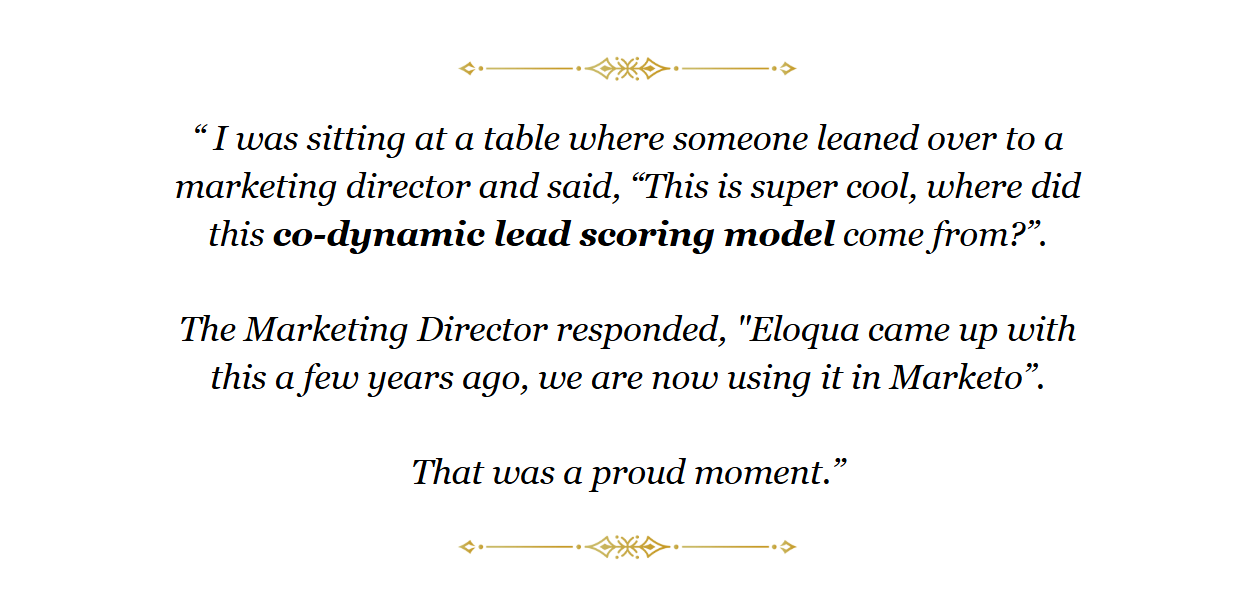
I’m most proud of the Lead scoring engine we built at Eloqua.
Technically it was innovative as it was able to process the digital body language of hundreds of millions of contacts in real time -something no other vendor was doing at the time. But we also introduced a product paired with a new way for marketers to qualify leads based on both explicit info (role, company) alongside implicit data (website visits, email activity etc). We called it Co-dynamic Lead Scoring.
Fast forward to Vena in 2019, we were at a revenue kick off event and marketing was presenting a new lead scoring system for sales. I was sitting at a table where someone leaned over to a marketing director and said, “This is super cool, where did this co-dynamic lead scoring model come from?”. The Marketing Director responded, "Eloqua came up with this a few years ago, we are now using it in Marketo”. That was a proud moment.
Your focus needs to shift from building products to building the business.
Invest in commercial acumen, communication, and judgment. Look for opportunities that stretch you beyond execution like the ones I’ve already mentioned: pricing, GTM, strategy, and company-wide initiatives.
Lead the transition to AI Product development lifecycles, but remember that judgment, customer understanding, and decision-making will become far more valuable than execution itself.
Finally, be intentional about building "career currency". The experiences you accumulate in scaling teams, leading through growth, or participating in a liquidity event compound over time and open doors throughout your career.
If you don’t see an ability to build that currency in your company, it's time to move on because you only get one career and it goes by fast.
I wish someone had told me that Product is fundamentally a decision-making profession.
If you are a Consultant and make a mistake, it impacts one customer. The wrong decision as a PM impacts all customers.
Early in my career I spent a lot of time trying to perfect requirements, roadmaps, and processes. Over time I realized those are the easier parts of PM and just tools. The real job is making high-quality decisions with incomplete information.
AI will increasingly automate the mechanics of Product, but judgment is much harder to automate. Looking back, I'd have spent far more time developing my decision-making skills and how to communicate them to various audiences.
Mentorship program and in-person event experiences are at an extra cost.
Join for free!Join the TPMA Slack Community with 1000+ members
Free Virtual TPMA events for the entire TPMA Season
Become the first to know about in-person events and networking opportunities
What does it actually take to reach the top of product management and stay there? For Andrew Stanbridge, SVP of Product at Vena Solutions, the answer has less to do with roadmaps and frameworks than most PMs would expect. Over nearly two decades in B2B SaaS, through companies like Eloqua, Achievers, and Collage HR, Andrew has navigated IPOs, acquisitions, and the kind of high-stakes decisions that define careers. In this edition of Product Star Spotlight, he shares the lessons that shaped him; on pricing, GTM, leadership, and on why product management is, at its core, a decision-making profession.
--
Pivot Point #1
The first was actually something I didn't do.
I was working in Premier Support at Eloqua and the Director of Marketing Ops wanted me to apply for a role to own the use of our own product. When I met with my boss to tell him I planned to apply, he asked me a question that stuck with me:
“Are you going after this role because it’s your calling, or just because it’s an opportunity?”
He told me to think about it over the weekend, because the next move I made would likely set the path for the rest of my career.
Over the weekend, I realized a career in marketing ops didn't actually excite me. What excited me was the idea of a new role and more money. So I went back in on Monday and told my boss I wasn't applying. Not long after, the folks on the product management team started asking me what our customers wanted to see changed in the product. That was my first peek into Product, and after a short period of time with that team, I knew it was what I wanted to do.
I waited for the next opening, applied, and transitioned into product management. In hindsight I realized this was one of the best examples of mentorship in action I’d experienced in my career and without it might not have found my professional calling.
Pivot Point #2
The second was a former colleague who asked me to do some product consulting for the company she worked at. Initially I wasn't interested in doing it for free, but ultimately decided it was a good opportunity to network and gain PM consulting experience.
That same woman later introduced me to the co-founder and CTO of Vena for a similar engagement, which is ultimately what led to me joining Vena. If I'd turned down that free consulting gig, I likely wouldn't be where I am today.
Pivot Point #3
The third was every liquidity event I've been part of. It's the ultimate milestone for a tech company, and something I came to realize later: having that experience under your belt is some of the most valuable career currency you can have. I think this is particularly important today in a world where average tenure has plummeted. You have to have really been a part of the company's liquidity journey to earn the “currency”.
First off, a proven ability to deliver and drive outcomes are prerequisites, not what actually differentiates you as you climb the seniority ladder.
Beyond that, it comes down to a few things:
There’s a lot of literature on this topic so I’ll just share a few learnings from my own experience.
Early Stage Startups
When you are a PM at a small start up, you wear many hats including customer success, support, implementation, design, and more. It’s obviously a lot of work but the benefit is getting super close to the customer and the day-to-day mechanics of the business. It gives you a depth of insight that's hard to replicate once those functions become specialized and separated from Product.
Scaling Up & Growing
As you scale, it's really hard to get the timing of hiring and new processes correct. Wait too long to hire, you cripple growth or burn out. Hire too quickly and you become inefficient. I love Brian Chesky's observation that every new person added to a team creates a hidden "communication tax" (extra meetings, emails, and admin overhead).
It always amazes me how many people obsess over designing the perfect process for every possible permutation, when that's often a poor use of time and energy. My own motto is "just enough process." There’s no exact science to this and my lesson learned is it’s amazing how easily you get caught up in the immediate horizon work. You need to consciously be taking a step back from the daily grind on a quarterly basis to assess team size, structure and processes.
Larger Companies
Product at larger companies typically pays the best but you will deal with two challenges.
The first is velocity – that communication tax I mentioned becomes real and you're constantly fighting to try and deliver product outcomes faster.
The second is you become removed from actually using your product. This is particularly true in product leadership but the business of product becomes more front and centre and it's very easy to lose your ability to actually demo, use and understand the details of how your users use your product. What happens naturally at start ups which is being in your product every day becomes something you have to consciously practice.
You've got to believe the company will be successful.
I see so many people excited to just get an offer, they don’t really look at the company they are joining. You need to Interview the company, and the market they play in, not just let the company interview you. Do you believe in their products, strategy, leadership?
The more senior you get the more in depth you should be getting into the business. For example asking about how they budget for Product; is it remaining flat as a percent of revenue? What’s their EBITDA? Are they hemorrhaging cash? Etc.
Educate yourself on equity.
Understand the differences between RSU’s, stock options, vesting periods, strike prices etc. Are you joining a public company where the stock price is public or a private company where it's pegged to a fund raising event?
A common pitfall I see is people looking to join private companies where recruiters dangle stock options as part of a total compensation package. They’ll say your total compensation is $200K. It has a $125K base and $75K options. When joining a company I advise people to make the decision assuming the options are worth nothing as it’s a lottery ticket with slightly better odds. The more you believe in the company, the more you personally can weigh asking for more stock options vs base salary.
I’ve been through liquidity events where the options ended up being worth $0 and others where they were worth far more than my strike price. It's largely out of your control and very hard to predict. A general rule of thumb is the longer a company has been around, the less likely it is your options will eventually be worth anything.
The 18 Month Allure
A liquidity event is never certain until it actually happens and the money is deposited into your account. I remember being at Eloqua and people saying, “we’re going public in 18 months”. We eventually did go public but several years after that hype started. On the first day at my next company a dev manager said, “you joined the right company, we’re going public in 18 months”. It never happened. Why 18 months? I’ve now learned that telling employees there will be a liquidity event in 18 months is close enough that it’s engaging for employees but far enough away that it’s not distracting to current fiscal year objectives.
Like I mentioned earlier, meaningfully being a part of one is massive career currency. The reason is executives and investors love hiring people who have that experience. Everyone talks about learning from failure and you certainly can. However if you fail at a start up, all you know is what to do or not do up to the point of scale where it failed. If you’ve been through a liquidity event you have the experience at every step of that journey. I can confidently say that my experience through liquidity events accelerated my career path at every level of Product.
Willingness to pay is the ultimate test of whether you've built something people actually value.
It's easy to feel good about a feature when it's free because you don't have to defend it. But when you charge for it, you can't hide behind documentation. You have to stand up and articulate why this is worth paying for.
What makes pricing hard yet fascinating is that it's part science, part psychology.
For example, why does a Nike t-shirt cost 3x an Amazon Essentials t-shirt? Brand, positioning, perceived pain relieved, competitive alternatives don't show up on a spec sheet, but it's all "priced in".
In B2B it gets even more challenging when you need to account for tiering, bundling, volume discounts, whether you segment by SMB/MM/ENT, whether you have transparent pricing, the list goes on. Internally, pricing is one of the most politically charged conversations in a company. Everyone from sales to finance to the CEO has an opinion, and usually a strong one as they are more senior than you.
That's exactly why I love it, if you want to find out whether you truly understand your customer, try pricing something for them!
To be clear, building anything new is genuinely hard, especially right now with agentic coding tools reshaping the development lifecycle faster than most teams can adapt their process to it. But building was never the part that surprised me. What surprised me is that in B2B SaaS, "if you build it, they will come" is a myth.
The hardest part of the job starts after launch, in the GTM engine.
Internally, you're trying to align a whole company around something new. Sales needs new talk tracks, CX needs to know how to support it, marketing needs a story etc., yet none of those people report to you.
That's the core paradox of product management: you have accountability without authority. You can't mandate change, you have to earn it by soliciting buy-in.
Externally, the customer world is busier than ever with every vendor fighting for customer attention. A customer can love your product and your brand and still never give you the 15min to hear about it. The best PM's know how to get scrappy by arming a sales rep with the right one-pager or doing a live demo for a skeptical CX team.
None of that works without strong communication skills and that's where I see a lot of PMs come up short. You can build the best product in the world, but if you can't stand up and “sell it”, tell its story clearly and repeatedly to a dozen different audiences, you will hit a ceiling in your PM career.
Consolidated Roles and Territorial Lines
Right now, AI tools like Figma and Claude Design are causing consolidation between product, design, and engineering faster than most orgs can adapt to capture the benefit.
A practical example of adapting is considering how the role of a Designer shifts from building prototypes to managing their design system as context for AI design tools. Prototypes that used to take days can now be built in a few hours, and that's breaking down the traditional handoff model (i.e., PM writes requirements, design mocks it up, engineering builds it). Teams need to rethink their development lifecycle now, or friction will emerge around old territorial lines. For example, I've already seen designers feel threatened by PMs building their own prototypes. The people who thrive in this shift are the ones who move fluidly across all three disciplines, not the ones guarding a legacy, narrow lane.
And there is a real cost consideration here. Prototyping with real customers and internal stakeholders is dramatically “cheaper” than it's ever been. But we all know the new cost that's emerged is token costs. Teams need to be treating them as a real design constraint, meaning you must be deliberate about how much prototyping depth a feature actually warrants relative to its risk and complexity. Don't just default to prototyping everything.
Visual UX Isn’t Disappearing
I was recently at an event listening to the head of AI at PayPal talk about voice as an emerging interface. Long term, I think he's right, but I don't think voice replaces UX; I think it sits alongside it.
For use cases like comparison, complex data review, or exploration, people still benefit from something to look at. But for quick, well-defined commands, voice can eliminate the need for a visual UI entirely and that has real implications for how software gets built. Product will increasingly have to decide, use case by use case, whether the interface should be voice at all, because if it is, there's no front end to design or development.
Less Orchestration, More Judgement
Looking ahead, PMs need to recognize the role itself is being compressed. I'm already seeing PM's transcribe a customer call, paste it into Cursor with spec-kit to generate code, and use Figma Make to generate a prototype. That whole chain from requirements to prototype to code is compressing into hours/minutes. Nobody's going to pay a PM well to copy-paste between tools. What actually matters is making high-quality decisions about what's worth building in the first place, rigorously testing whether the output actually meets the bar before it ships, deeply understanding your customer and domain, and driving the GTM motion once it's out. I think these focus areas are where Product is headed. Ultimately less orchestration, and more judgment.
A few years ago I was at a JMI Equity event listening to Harry Gruner, JMI’s co-founder do a fireside chat about Product and Tech board sessions. The crux of the chat was that investors speak the language of dollars and cents and aren’t familiar with the features and functions of your product. Far too often CTO’s and CPO’s show up to board meetings talking about features and not about commercial outcomes. That learning best summarizes the key to success when communicating with these audiences.
Here are a few examples:
I’m most proud of the Lead scoring engine we built at Eloqua.
Technically it was innovative as it was able to process the digital body language of hundreds of millions of contacts in real time -something no other vendor was doing at the time. But we also introduced a product paired with a new way for marketers to qualify leads based on both explicit info (role, company) alongside implicit data (website visits, email activity etc). We called it Co-dynamic Lead Scoring.
Fast forward to Vena in 2019, we were at a revenue kick off event and marketing was presenting a new lead scoring system for sales. I was sitting at a table where someone leaned over to a marketing director and said, “This is super cool, where did this co-dynamic lead scoring model come from?”. The Marketing Director responded, "Eloqua came up with this a few years ago, we are now using it in Marketo”. That was a proud moment.
Your focus needs to shift from building products to building the business.
Invest in commercial acumen, communication, and judgment. Look for opportunities that stretch you beyond execution like the ones I’ve already mentioned: pricing, GTM, strategy, and company-wide initiatives.
Lead the transition to AI Product development lifecycles, but remember that judgment, customer understanding, and decision-making will become far more valuable than execution itself.
Finally, be intentional about building "career currency". The experiences you accumulate in scaling teams, leading through growth, or participating in a liquidity event compound over time and open doors throughout your career.
If you don’t see an ability to build that currency in your company, it's time to move on because you only get one career and it goes by fast.
I wish someone had told me that Product is fundamentally a decision-making profession.
If you are a Consultant and make a mistake, it impacts one customer. The wrong decision as a PM impacts all customers.
Early in my career I spent a lot of time trying to perfect requirements, roadmaps, and processes. Over time I realized those are the easier parts of PM and just tools. The real job is making high-quality decisions with incomplete information.
AI will increasingly automate the mechanics of Product, but judgment is much harder to automate. Looking back, I'd have spent far more time developing my decision-making skills and how to communicate them to various audiences.
Toronto Product Management Association (TPMA) is a community focused on development, growth and networking of Product professionals in the Greater Toronto Area.



.png)
