The Fall Product Mentorship Program is Open! Mentors and Mentees apply by Sept 24!

There. I said it.
And if you've been to a TPMA event or any event lately, you already know this isn't just me. AI comes up every single time. Every conversation, every panel, every coffee break. It's everywhere.
But here's what doesn't come up as often: how many of us are quietly nodding along while internally wondering if we're the only ones who haven't figured this out yet.
You're not. I promise.
I've talked to enough PMs to know this feeling is more common than anyone lets on. We just rarely say it out loud.
I'm a Senior PM in InsurTech. This year, our company went all in on AI, and it came from senior leadership. Like when Shopify mandated all employees to use AI last year - we were challenged with something similar.
Almost overnight, our Slack channels for AI help and AI discussions exploded. People who hadn't touched these tools started showing up with questions, experiments, and wins. Copilot, Rovo, and Claude. Suddenly, AI wasn't something our teams were experimenting with on the side. It was part of the job.
Having senior leadership supporting the learnings of AI goes a long way, and I am thankful for that.
What I've come to realize is that everyone on every team is at a different stage with AI. Developers had already been using Claude Code for months, while others were just getting started with the basics. And there I was, somewhere in the middle, trying to make sense of all of it while nothing around me was slowing down, including the AI industry itself.
That feeling — the hamster wheel feeling — is real. There is always something new. Always another model, another tool, another LinkedIn post telling you you're already behind.
I needed to take a step back and catch my breath. I felt like I was constantly trying to keep up with the news, and it was exhausting. So I gave myself some guidance, and it helped: Stop trying to keep up with everything and focus on what actually helps you right now.
Think about it the same way you think about product prioritization.
As PMs, we're always asking: what's the most valuable thing to ship right now? Apply that same lens to how you learn AI. Everyone is at a different stage. So prioritize the things that matter to YOU at YOUR stage. Everything else is noise. The more you focus on that, the better your outcomes, and the less overwhelmed you feel.
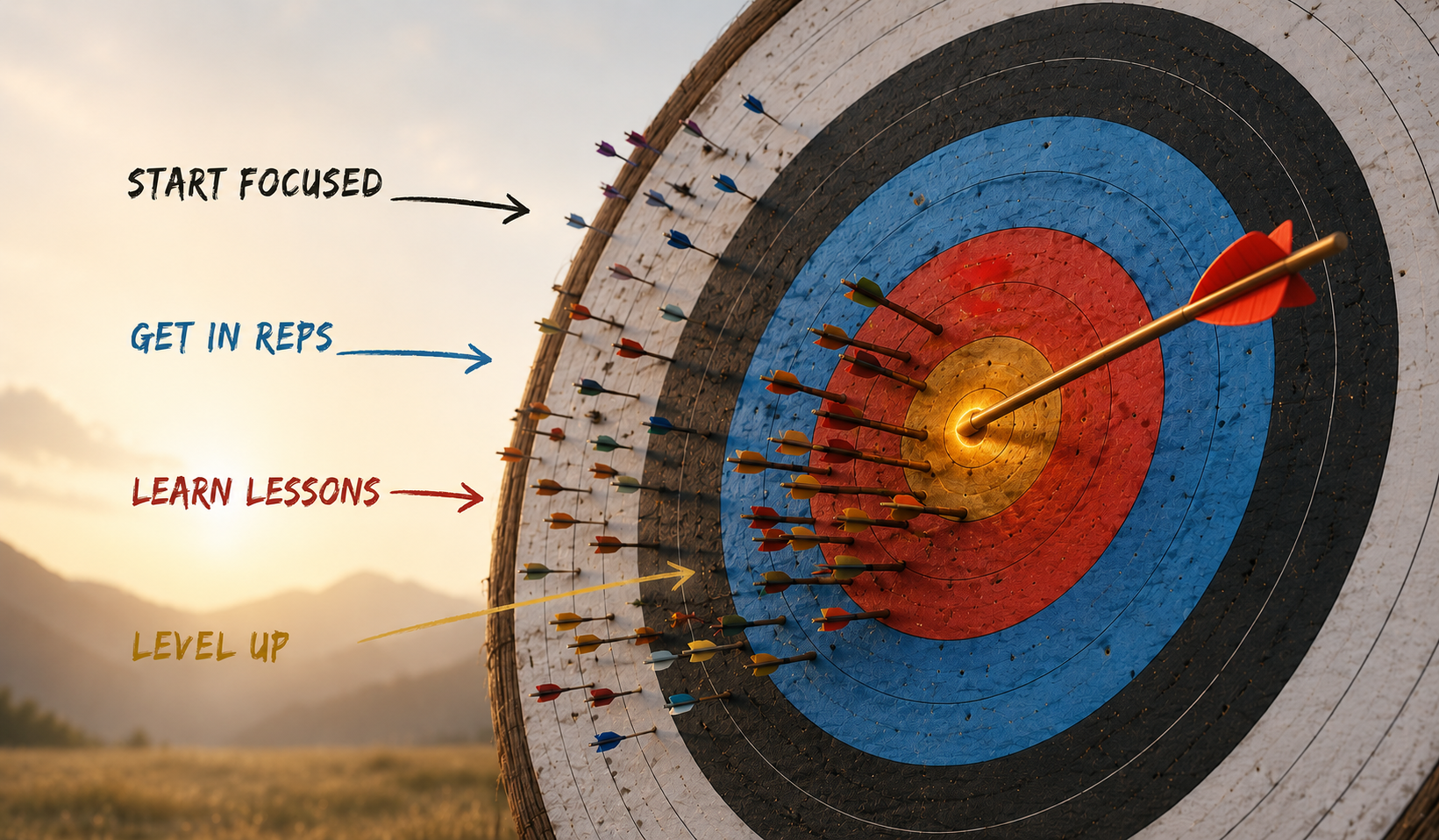
For example, if you're just getting started, you don't need to know the difference between the latest model releases and features. That's like learning to swim and immediately worrying about perfecting an Olympic flip turn. Start with the basics. Get reps in. You'll know when you're ready for the next level.
And when you do get your reps in, the shift is real. I went from feeling like I was constantly catching up, to following Claude's latest releases out of genuine curiosity, to then being the one in the room saying, "Did you see Claude just dropped a design tool? Let's get access." And it all started by focusing on what was actually relevant to me.
Let me get specific with a few things every PM knows too well.
A Good Chat with a Knowledge Base
We all have Confluence pages. Hundreds of them. Documents, research, decision logs, context that lives somewhere in a wiki that nobody has time to read end to end.
In the pre-AI era, joining a new team meant weeks of catching up, with hours and hours of reading pages. Tracking down the right person to explain the WHY behind a decision made a year ago. Asking for context, then asking for more context.
I've done this multiple times recently; once when I joined the company, and again when I joined the current project, which had two years of research sitting behind it. Two years. That's a lot of Confluence pages.
With Rovo (Atlassian), I could just ask. Summarize this. Explain the context behind this decision. What's the user problem we're solving? What's been tried before?
And then the part that changed everything: I could go back and forth with it like a real conversation.
Not searching, reading, scanning. Just talking through it until I actually understood. What used to take weeks now took days.
From PRD to Prototype and Back
The next bigger experiment was Figma Make. Early this year, before the token limits tightened up, I went all in. The idea was to use it to replace the traditional PRD process. (I mean, come on, who likes writing those long PRDs?) Building a working prototype was much more fun!
And it worked. For a while.
Getting alignment was faster. Bouncing ideas around with designers and SMEs felt more concrete. People could actually see what I was talking about, rather than reading a document and imagining it differently in their heads. The engineers even said the prototype helped them understand the product: what it was supposed to do and how it should work.
But when we actually used it during engineering handoff, things started to fall apart.
The root of the problem is Figma Make doesn't follow our design system. So the code it generated wasn't using our components, wasn't following our standards, and the engineers couldn't build from it cleanly. So we reframed how we used it. It is not to replace PRDs but for alignment, iteration, and speed of thinking, rather than treating it as a bridge to production implementation.
The next shift came when we got access to Claude Cowork and Code, which unlocked a whole new playing field.
It felt like a promotion. I went from doing everything myself to managing a team of highly skilled interns - interns that are knowledgeable, fast, and always available. I delegate tasks, they report back when they are done, and I make the judgment call on what to keep, what to tweak, and what to do next. The work still gets done. I just don't have to do all of it myself.
This all led to better PRDs,and cleaner user stories. Most importantly, engineers were able to generate better, more trusted code from it.
We’ve been using MCP to connect Figma directly to Jira, and now we're exploring something called Speckit, trying to automate the handoffs with saferails so that nobody has to copy-paste anything anymore. The goal is proper handoffs without losing context at every step.
We're not there yet - and that's the point. Every experiment compounds into the next, and each one reshapes how I think about what comes after.
The grunt work is slowly (but quickly) being handled: updating Jira tickets, writing acceptance criteria, drafting PRDs, and writing QA documentation. The things that used to eat half your week can now be largely automated.
And honestly, good.
Here's something worth saying out loud: that grunt work was never really the PM's job to begin with.
It was the product owner's scope, but over time, it just got absorbed into what we do as PMs. So gradually, and so insistently, that for a lot of us, it became almost all we do. We were so busy executing that we barely had time to think strategically.
AI is giving us that time back. Not to do less, but to do more - more of what we were actually hired to do.
More time talking to customers; understanding their problems, their frustrations, what keeps them up at night. More time watching the market, tracking competitors, and figuring out where to place our bets. More time on product strategy - the real work of deciding what to build and why. The stuff that actually moves the needle.
If you ask me, that's a great trade.
The best thing AI is doing for product management isn't the tactical automation of the grunt work; it’s the reminder to us that the grunt work was never the job.
Think of it this way: you now have agents doing the work that used to sit at the bottom of your to-do list. Competitor research, scraping newsletters, summarizing customer feedback, and drafting responses to feature requests.
And that was another thing I did with AI: I set up a weekly competitor analysis using Copilot and Claude.
Every week, it pulls together what competitors are doing, what customers expect, and what features are gaining traction. I used to skip this entirely. Now I make better decisions because of it.
Recently, a mentee of mine finished a PM course. He came back fired up, notebook full of frameworks, ready to apply everything. And when we debriefed, the fundamentals he learned were the same ones I learned years ago. Understanding the user problem. Knowing the WHY. Making sure you're solving the right thing, not just building things fast.
Because in a world where AI is automating the execution layer, those fundamentals aren't becoming less important; they're becoming the only thing that separates a good PM from a replaceable one. The execution layer is getting faster. The judgment layer is still yours.
Let's go back to the intern analogy for a second.
I said getting access to agents felt like a promotion. But it doesn't have to stop there. We can now create agents and subagents. Which means you don't just have interns anymore. You have a team of teams.
And with that comes an even bigger question: what work should they be doing, and how should they work together so you can perform your job even better? How do you place bigger bets? How do you perform at a level you couldn't before?
That's a fundamentally different way of thinking, and it's where adaptability becomes the most important skill a PM can have right now.
Because here's the reality: just when you think you've got something working, something new drops and blows it out of the water. You start over. You learn again. You adapt. That hamster wheel feeling doesn't go away, but the wheel is no longer a wheel - it’s a ramp. And you're no longer running to keep up - you're running to stay sharp.
A coworker of mine didn't have access to Claude through work yet. Before his access came through, he set it up on his personal laptop and started experimenting on his own time. And if that’s the situation you’re in, that's the move.
Not because everyone needs to go out of pocket for tools, but because the people learning fastest right now aren't waiting for permission or the perfect setup. They're just starting - with something, somewhere, somehow. And the real investment is the one you make in yourself by starting.
The question hasn’t changed, even as AI evolves: how do we use tools to become better product managers?
That’s part of the job now. The PMs who keep asking that question are the ones who keep moving forward.
So keep going.
No Regrets. Just Lessons.
Mentorship program and in-person event experiences are at an extra cost.
Join for free!Join the TPMA Slack Community with 1000+ members
Free Virtual TPMA events for the entire TPMA Season
Become the first to know about in-person events and networking opportunities
There. I said it.
And if you've been to a TPMA event or any event lately, you already know this isn't just me. AI comes up every single time. Every conversation, every panel, every coffee break. It's everywhere.
But here's what doesn't come up as often: how many of us are quietly nodding along while internally wondering if we're the only ones who haven't figured this out yet.
You're not. I promise.
I've talked to enough PMs to know this feeling is more common than anyone lets on. We just rarely say it out loud.
I'm a Senior PM in InsurTech. This year, our company went all in on AI, and it came from senior leadership. Like when Shopify mandated all employees to use AI last year - we were challenged with something similar.
Almost overnight, our Slack channels for AI help and AI discussions exploded. People who hadn't touched these tools started showing up with questions, experiments, and wins. Copilot, Rovo, and Claude. Suddenly, AI wasn't something our teams were experimenting with on the side. It was part of the job.
Having senior leadership supporting the learnings of AI goes a long way, and I am thankful for that.
What I've come to realize is that everyone on every team is at a different stage with AI. Developers had already been using Claude Code for months, while others were just getting started with the basics. And there I was, somewhere in the middle, trying to make sense of all of it while nothing around me was slowing down, including the AI industry itself.
That feeling — the hamster wheel feeling — is real. There is always something new. Always another model, another tool, another LinkedIn post telling you you're already behind.
I needed to take a step back and catch my breath. I felt like I was constantly trying to keep up with the news, and it was exhausting. So I gave myself some guidance, and it helped: Stop trying to keep up with everything and focus on what actually helps you right now.
Think about it the same way you think about product prioritization.
As PMs, we're always asking: what's the most valuable thing to ship right now? Apply that same lens to how you learn AI. Everyone is at a different stage. So prioritize the things that matter to YOU at YOUR stage. Everything else is noise. The more you focus on that, the better your outcomes, and the less overwhelmed you feel.
For example, if you're just getting started, you don't need to know the difference between the latest model releases and features. That's like learning to swim and immediately worrying about perfecting an Olympic flip turn. Start with the basics. Get reps in. You'll know when you're ready for the next level.
And when you do get your reps in, the shift is real. I went from feeling like I was constantly catching up, to following Claude's latest releases out of genuine curiosity, to then being the one in the room saying, "Did you see Claude just dropped a design tool? Let's get access." And it all started by focusing on what was actually relevant to me.
Let me get specific with a few things every PM knows too well.
A Good Chat with a Knowledge Base
We all have Confluence pages. Hundreds of them. Documents, research, decision logs, context that lives somewhere in a wiki that nobody has time to read end to end.
In the pre-AI era, joining a new team meant weeks of catching up, with hours and hours of reading pages. Tracking down the right person to explain the WHY behind a decision made a year ago. Asking for context, then asking for more context.
I've done this multiple times recently; once when I joined the company, and again when I joined the current project, which had two years of research sitting behind it. Two years. That's a lot of Confluence pages.
With Rovo (Atlassian), I could just ask. Summarize this. Explain the context behind this decision. What's the user problem we're solving? What's been tried before?
And then the part that changed everything: I could go back and forth with it like a real conversation.
Not searching, reading, scanning. Just talking through it until I actually understood. What used to take weeks now took days.
From PRD to Prototype and Back
The next bigger experiment was Figma Make. Early this year, before the token limits tightened up, I went all in. The idea was to use it to replace the traditional PRD process. (I mean, come on, who likes writing those long PRDs?) Building a working prototype was much more fun!
And it worked. For a while.
Getting alignment was faster. Bouncing ideas around with designers and SMEs felt more concrete. People could actually see what I was talking about, rather than reading a document and imagining it differently in their heads. The engineers even said the prototype helped them understand the product: what it was supposed to do and how it should work.
But when we actually used it during engineering handoff, things started to fall apart.
The root of the problem is Figma Make doesn't follow our design system. So the code it generated wasn't using our components, wasn't following our standards, and the engineers couldn't build from it cleanly. So we reframed how we used it. It is not to replace PRDs but for alignment, iteration, and speed of thinking, rather than treating it as a bridge to production implementation.
The next shift came when we got access to Claude Cowork and Code, which unlocked a whole new playing field.
It felt like a promotion. I went from doing everything myself to managing a team of highly skilled interns - interns that are knowledgeable, fast, and always available. I delegate tasks, they report back when they are done, and I make the judgment call on what to keep, what to tweak, and what to do next. The work still gets done. I just don't have to do all of it myself.
This all led to better PRDs,and cleaner user stories. Most importantly, engineers were able to generate better, more trusted code from it.
We’ve been using MCP to connect Figma directly to Jira, and now we're exploring something called Speckit, trying to automate the handoffs with saferails so that nobody has to copy-paste anything anymore. The goal is proper handoffs without losing context at every step.
We're not there yet - and that's the point. Every experiment compounds into the next, and each one reshapes how I think about what comes after.
The grunt work is slowly (but quickly) being handled: updating Jira tickets, writing acceptance criteria, drafting PRDs, and writing QA documentation. The things that used to eat half your week can now be largely automated.
And honestly, good.
Here's something worth saying out loud: that grunt work was never really the PM's job to begin with.
It was the product owner's scope, but over time, it just got absorbed into what we do as PMs. So gradually, and so insistently, that for a lot of us, it became almost all we do. We were so busy executing that we barely had time to think strategically.
AI is giving us that time back. Not to do less, but to do more - more of what we were actually hired to do.
More time talking to customers; understanding their problems, their frustrations, what keeps them up at night. More time watching the market, tracking competitors, and figuring out where to place our bets. More time on product strategy - the real work of deciding what to build and why. The stuff that actually moves the needle.
If you ask me, that's a great trade.
The best thing AI is doing for product management isn't the tactical automation of the grunt work; it’s the reminder to us that the grunt work was never the job.
Think of it this way: you now have agents doing the work that used to sit at the bottom of your to-do list. Competitor research, scraping newsletters, summarizing customer feedback, and drafting responses to feature requests.
And that was another thing I did with AI: I set up a weekly competitor analysis using Copilot and Claude.
Every week, it pulls together what competitors are doing, what customers expect, and what features are gaining traction. I used to skip this entirely. Now I make better decisions because of it.
Recently, a mentee of mine finished a PM course. He came back fired up, notebook full of frameworks, ready to apply everything. And when we debriefed, the fundamentals he learned were the same ones I learned years ago. Understanding the user problem. Knowing the WHY. Making sure you're solving the right thing, not just building things fast.
Because in a world where AI is automating the execution layer, those fundamentals aren't becoming less important; they're becoming the only thing that separates a good PM from a replaceable one. The execution layer is getting faster. The judgment layer is still yours.
Let's go back to the intern analogy for a second.
I said getting access to agents felt like a promotion. But it doesn't have to stop there. We can now create agents and subagents. Which means you don't just have interns anymore. You have a team of teams.
And with that comes an even bigger question: what work should they be doing, and how should they work together so you can perform your job even better? How do you place bigger bets? How do you perform at a level you couldn't before?
That's a fundamentally different way of thinking, and it's where adaptability becomes the most important skill a PM can have right now.
Because here's the reality: just when you think you've got something working, something new drops and blows it out of the water. You start over. You learn again. You adapt. That hamster wheel feeling doesn't go away, but the wheel is no longer a wheel - it’s a ramp. And you're no longer running to keep up - you're running to stay sharp.
A coworker of mine didn't have access to Claude through work yet. Before his access came through, he set it up on his personal laptop and started experimenting on his own time. And if that’s the situation you’re in, that's the move.
Not because everyone needs to go out of pocket for tools, but because the people learning fastest right now aren't waiting for permission or the perfect setup. They're just starting - with something, somewhere, somehow. And the real investment is the one you make in yourself by starting.
The question hasn’t changed, even as AI evolves: how do we use tools to become better product managers?
That’s part of the job now. The PMs who keep asking that question are the ones who keep moving forward.
So keep going.
No Regrets. Just Lessons.
Toronto Product Management Association (TPMA) is a community focused on development, growth and networking of Product professionals in the Greater Toronto Area.



.png)
